Smooth Transitions with Fast-Drying Paint: How to Blend Acrylics Without Fighting the Clock
Art Team
June 6th, 2026
No Comments
Mastering Acrylic Blending: A Comprehensive Guide
1. Why Blending Acrylics Feels Harder Than It Looks
When you first switch to acrylics—or try to get those soft, buttery blends you see in oil paintings—it’s easy to hit a wall. Acrylics dry fast. They go from workable to tacky in minutes, especially on absorbent canvas or in a warm room. Once they hit that sticky stage, any further brushing tends to tear the surface or create uneven patches instead of smooth transitions.
Common frustrations include:
Hard edges where two colors meet instead of a gradual gradient.
Brush marks that refuse to disappear.
Colors turning muddy when you work them too long.
“Chalky” or streaky blends when you use too much water.
The good news: those problems usually come from a few fixable factors—paint consistency, timing, brush choice, and working method. Once you understand how acrylics behave, you can blend them reliably in several ways without needing to switch to oils.
This guide walks through the main blending strategies—wet-on-wet, wet-on-dry, glazing, and special tools—plus drying-time hacks and practice exercises to improve your control.
I. Definitions and Obstacles
1. What “Blending” Actually Means in Acrylics
In practical terms, blending is creating a gradual transition between two colors or values so that you can’t see a hard border between them. That might be: A smooth gradient from dark to light in a sky; A soft shift from one skin tone to another in a portrait; A gentle change from warm to cool in a background.
With acrylics, you can achieve this in three broad ways:
Wet-on-wet blending: physically mixing the colors on the surface while both are still wet.
Wet-on-dry blending (layered blending): painting successive semi-transparent layers over dry paint to simulate a smooth transition.
Glazing and feathering: layering transparent color and softening edges to visually blend tones.
You don’t have to pick just one. Many painters combine them: rough in with wet-on-wet, refine with glazes and wet-on-dry adjustments.
2. Controlling the Enemies of Smooth Blends
Three main obstacles make acrylic blending difficult:
Fast drying time: Acrylics can start to skin over on the palette and canvas within minutes. Once paint is tacky, further brushing lifts and streaks rather than blends.
High viscosity (thickness): Heavy-body acrylics hold brush marks strongly, which is great for texture but tough for silk-smooth gradients.
Overworking and over-watering: Scrubbing too much creates mud and streaks. Diluting paint with excessive water weakens it, makes it patchy, and can cause uneven sheen.
The strategies below target these issues directly: slowing drying, optimizing paint consistency, using the right brushes, and minimizing overworking.
II. Tools and Paint Consistency
1. Choosing Brushes and Surfaces for Easier Blends
Your tools can either fight or support your blending.
4.1. Brush types that help blending: Large flat brushes (synthetic) are great for big gradients like skies and backgrounds. Use them to lay down initial bands of color. Soft blending brushes / mop brushes are very soft, fluffy (often natural or very soft synthetic). Used dry or barely damp for gentle smoothing strokes over wet paint. Filberts have rounded ends help blend without sharp marks and are good for transitions on curved forms. Round brushes with good spring are useful for smaller, controlled blends or feathering edges. Avoid very stiff bristle brushes for final blending; they tend to leave grooves and can disturb semi-dry layers.
4.2. Surface matters: Smoother surfaces (gessoed panels, well-sanded gesso on canvas) make it easier to get seamless gradients. Very rough canvas texture catches paint and emphasizes brush marks, which can be great for texture but harder for smooth blends. If your blends keep catching on the weave, consider: Adding an extra coat or two of gesso and lightly sanding, or trying a panel or smoother canvas for blend-heavy work.
2. Adjusting Paint Consistency: Not Too Thick, Not Too Thin
Blending is much easier when your paint is at the right consistency—thick enough to cover, thin enough to move. Key options:
Use a bit of water, but not too much: A small amount of water (to “milk” or “cream” consistency) can help brushwork and mixing. Too much water reduces opacity and can create streaks or disturb the underlying layer.
Use fluid medium to lower viscosity: Acrylic mediums (especially slow-dry or glazing mediums) thin paint and increase flow without weakening the film. They also often give you more open time for blending.
Use slow-dry / retarders: These additives slow drying, sometimes by up to 40% or more. They can be especially helpful for large blends.
A balanced approach: For large gradients: paint + a little water + a bit of slow-dry or fluid medium. For subtle layered blends (glazing): paint + glazing medium, very little or no extra water.
III. Blending Methods and Techniques
1. Wet-on-Wet Blending: Working While the Paint Is Fresh
Wet-on-wet is the most intuitive blending method: you apply two colors while they’re still wet and physically mix them on the canvas.
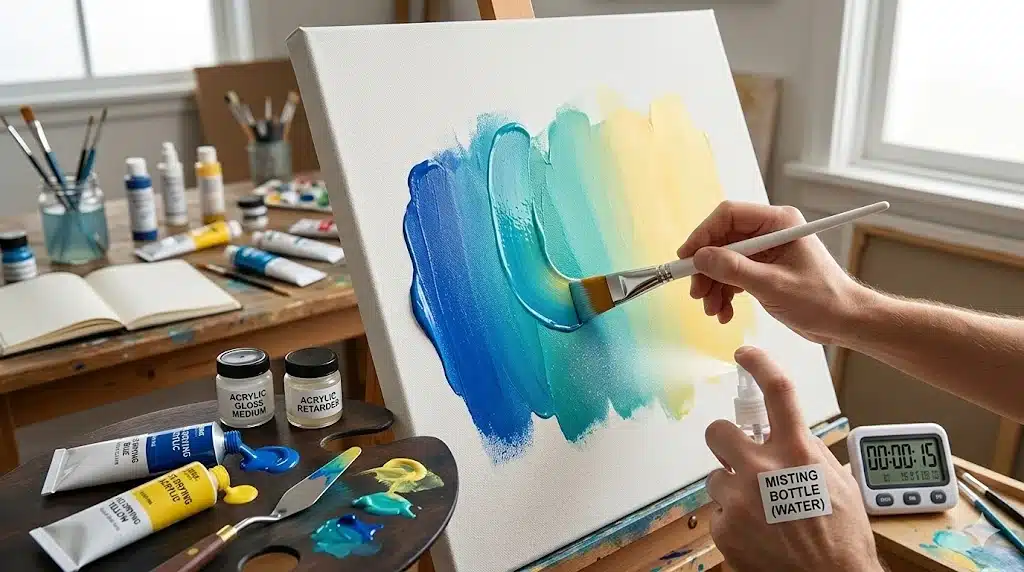
6.1. Basic wet-on-wet band blend: Prep the area: If desired, lightly dampen the surface with a clean, wet brush (not dripping). This can help paints glide and stay wet longer. Paint band A: Lay down your first color (e.g., blue) over its area with a flat brush. Paint band B: Immediately paint the second color (e.g., white or a lighter blue) next to it, leaving a small overlap zone. Blend the seam: With a clean, slightly damp brush, stroke back and forth across the line where the two colors meet, moving your arm across the seam to drag some of each color into the overlap zone. Work quickly; if the paint starts to drag or feel sticky, stop rather than overwork. Soft mop pass (optional): Use a clean, dry blending brush or mop brush and very lightly go over the transition area once, edge to edge, to smooth further. This technique is especially effective for simple two-color gradients such as skies, backgrounds, and glow effects.
6.2. Multi-color wet blend: For three or more colors (e.g., sunset sky): Work from lightest to darkest or vice versa. Apply each band quickly, making sure adjacent bands are still wet. Blend each seam in turn, then optionally do a final, gentle blending pass with a dry brush or sponge along the whole gradient.
2. Wet-on-Dry Blending: Layering and Feathering Transitions
Because acrylics dry fast, you’ll often end up blending over dry paint. Instead of fighting to rehydrate, use layering to your advantage. This is wet-on-dry blending.
7.1. Feathering technique: Feathering is a way to soften an edge by slightly overlapping a new wet stroke onto a dry area and then “lifting” or dragging the edge. Paint your first area and let it dry. Load a brush with your second color. Apply the second color next to the dry first color, slightly overlapping. Rinse your brush, blot to damp, then gently drag the damp brush along the boundary to pull a bit of the wet color into the dry region, softening the edge. Repeat with light touches rather than heavy scrubbing. Done in multiple passes with slightly different values, this can build very soft transitions without ever having both colors fully wet at the same time.
7.2. Layered blending (step gradients): Another approach is to build a gradient using many small value/colour steps: Paint your base color and let it dry. Mix a mid-step color between your base and target color. Paint a narrow band of this mid-step across the transition area. Blend its edges slightly while wet (with a damp brush or sponge). Repeat with additional intermediate mixes until the jump between steps becomes nearly invisible. This is slower but very controlled—excellent for realism and smooth surfaces.
3. Glazing for Optical Blends
Glazing is a form of wet-on-dry blending in which you use transparent layers of color over dry paint to adjust value and hue gradually. Key points: Use a glazing medium or fluid medium + a small amount of paint color. Apply thin, transparent layers and let each dry completely before adding the next. Each glaze shifts the underlying color slightly, building a smooth transition without heavy mixing.
Example: You have a blue area and want it to transition toward purple. Over the blue, glaze thin layers of red-violet toward one side. Multiple passes gradually enrich and darken the purple area, creating a soft transition from blue to purple. Glazing is particularly useful for: Subtle skin transitions, Atmospheric gradients (fog, depth), Correcting or softening blends that are already dry. Because each glaze is transparent, they preserve luminosity when done thinly and with good mediums.
4. Using Special Tools: Mop Brushes, Sponges, and More
9.1. Mop or blending brushes: These are very soft, fluffy brushes used dry (or almost dry) to gently stroke over wet paint: After applying two neighboring colors and roughly blending their seam, use a clean, dry mop brush to lightly brush across the entire gradient once. Use only the tips, with minimal pressure, to avoid disturbing lower layers. This can even out slight banding and soften any visible strokes.
9.2. Sponges: Sponges are excellent for creating smooth yet textured blends: Use a clean, slightly damp sponge piece. Dab (don’t drag) across the meeting area of two wet colors, lifting and mixing them in place. Continue dabbing into surrounding areas to distribute the transition. Sponges are especially effective for: Cloudy skies, Backgrounds for portraits or florals, Soft-focus or bokeh-like effects.
9.3. Fan brushes and makeup brushes: A fan brush can softly flick or sweep across transitions, but it can be tricky and streaky if overused. Some artists use clean, soft makeup brushes for final smoothing, similar to mop brushes.
IV. Mastery and Maintenance
1. Slowing Down Drying Time: Your Best Ally
Because drying speed is the main enemy of wet-on-wet blending, consider techniques that extend open time.
Use a stay-wet palette: Keeps paints workable longer on the palette so you aren’t already fighting semi-dried blobs.
Mist your palette and canvas lightly: A fine mist spray bottle can keep surface moisture up, but avoid over-spraying, which can cause drips and dilute paint excessively.
Add slow-dry or retarder medium: Many brands offer slow-dry mediums specifically designed to extend open time by 20–40% or more. Mix sparingly; follow manufacturer ratios.
Work in sections: Blend one area at a time (e.g., just the sky today), rather than jumping around the canvas, so you can focus before it dries.
Control environment: Avoid painting under direct hot lamps or in very hot, dry air when you want extended blending time. If possible, maintain moderate humidity and temperature.
2. Avoiding Mud and Over-Blending
A common beginner mistake is to blend too long. Acrylics reward decisive strokes rather than endless reworking. Signs you’re over-blending: Colors lose their clarity and turn neutral or gray. The surface starts to look scumbled and chalky instead of smooth. You feel like the paint is resisting each new stroke.
Solutions: Limit yourself to a few passes over any given area. If things start to go wrong, stop, let it dry, and correct with glazing or wet-on-dry blending instead of pushing wet paint further. Mix intermediate colors on the palette rather than relying entirely on on-canvas mixing. Remember: it’s often easier to layer your way to a blend than to force everything to happen in one wet session.
3. Simple Practice Exercises to Improve Your Blends
Exercise 1: Two-color gradient strip: On a primed board or canvas: Draw several long rectangular strips. For each strip, choose two colors (e.g., blue → white, red → yellow, green → black). Practice creating a gradient in each strip using a different method: Wet-on-wet band blend, Wet-on-dry feathering, Multiple glazed layers.
Exercise 2: Sky panel with three colors: Divide a small canvas into thirds vertically. Paint the top third dark blue, middle third mid-blue, and bottom third pale yellow or light orange. Use wet-on-wet blending and a mop or blending brush to soften the seams into a smooth sky gradient. Repeat with small tweaks to see what changes.
Exercise 3: Sphere shading study: Draw three simple circles on a smooth surface. Underpaint them flat mid-tone. On each, practice blending from light to dark: Circle 1 (pure wet-on-wet), Circle 2 (wet-on-dry), Circle 3 (mostly glazing). This forces you to think about light, form, and edge softness.
V. Styles and Troubleshooting
1. Matching Blending Methods to Subject Matter
Skies, water, and backgrounds: Often benefit from large, wet-on-wet blends, sponges, and mops. Glazing can adjust color after the basic gradient is established.
Portraits and skin tones: Tend to favor wet-on-dry blending and glazing for controlled transitions. Small, soft brushes and slow-dry mediums help.
Fur, foliage, and textured surfaces: Need controlled roughness; heavy smoothing can remove character. Use partial blends, broken color, and dry-brush rather than full gradients.
Graphic or stylized work: May intentionally avoid heavy blending, using distinct shapes and crisp edges instead. A tiny amount of feathering can still polish transitions if desired.
2. Common Mistakes and How to Fix Them
Mistake 1: Using only water as “medium”. Problems: Excess water can lead to weak coverage and streaks. Fix: Use acrylic mediums—especially fluid or slow-dry mediums—to adjust flow and open time.
Mistake 2: Trying to blend across the whole canvas at once. Problems: Areas dry before you get back to them. Fix: Work in manageable sections.
Mistake 3: Scrubbing instead of gently blending. Problems: Scrubbing disturbs drying paint and creates uneven texture. Fix: Use softer brushes and lighter pressure. Think “gliding and feathering.”
Mistake 4: Expecting acrylic to behave like oils. Problems: Overworking because you assume you can keep blending indefinitely. Fix: Embrace acrylic’s character: work quicker, use mediums, and rely on layering.
3. Developing Your Personal Blending Style
Not every painter wants perfectly airbrushed transitions. Some prefer visible, directional strokes, broken color, or soft backgrounds with sharp foregrounds. Use these techniques to support your vision. As you practice: Notice where you want hard edges and where you want soft edges. Decide how much texture you want visible. Choose blending methods that enhance that balance rather than erase it.
Confused by acrylic mediums? Learn what gels, fluids, retarders, and other additives actually do, how brands differ, and which ones are genuinely useful for your painting style.
Discover the history, techniques, and practical tips behind en plein air painting. Learn how to capture spring’s fleeting light and color with confidence and authenticity.
Oil Painting Curriculum: 10 Projects for Beginners 1. Getting Started: Why Projects Beat Theory Reading about color theory and brush types has value, but confidence with oils really comes from…
Struggling with portraits that look “off”? Learn the core proportions of the human face—eyes, nose, mouth, ears—and how to place them accurately using simple thirds and fifths for more realistic…
Learn exactly how to stretch watercolor paper so it stays flat under heavy washes. Tools, soaking times, taping methods, drying tips, and common mistakes explained.
Learn what linseed oil does in oil painting, the different types available, how to use it safely with the fat-over-lean rule, and when to keep your mixtures simple.