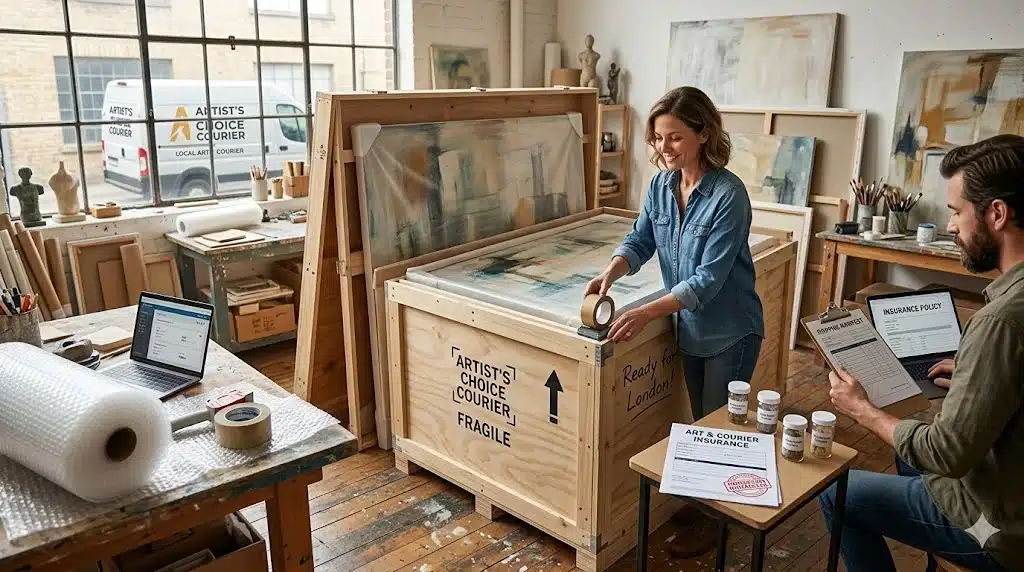
1. The Hook: The Shipment You Track With Your Heart in Your Throat
There is a particular kind of anxiety that only artists and art handlers know.
You have just finished a large piece — a two meter canvas, a fragile wall sculpture, a multi-panel installation. It is the kind of work that stretched you technically and emotionally. You crate it, fill out the labels, hand it over to the carrier, and then spend the next week refreshing the tracking page like it is a heart monitor.
Every status update feels like a pulse: “In transit.” “Arrived at hub.” “Out for delivery.” You imagine forklift tines missing the crate by centimeters, sudden rainstorms on loading docks, a rushed worker dropping a side of the box. And then a darker thought: If something goes wrong, am I actually protected? Or am I just hoping for the best?
Shipping large scale art is not just a logistics problem. It is a vulnerability problem. You are sending something irreplaceable into a system that treats most packages as anonymous rectangles. The difference between a nightmare and a smooth delivery often comes down to three things: how you crate, who you trust to move it, and what insurance you put in place.
This is where we slow down, breathe, and treat shipping as part of your craft — not an afterthought.
2. Deep Dive: Understanding What Large Scale Art Endures in Transit
Before we talk about materials and insurance policies, you need to understand what your artwork is actually subjected to during shipment.
2.1. The Physical Reality: Drops, Vibrations, and Weather
Even with careful handlers, large packages are exposed to:
- Rotational corner and edge drops when crates are tipped or shifted off pallets.
- Vibrations from truck engines, aircraft cargo holds, and conveyor systems that can loosen hardware or fatigue weak points over long distances.
- Sudden temperature and humidity shifts that cause canvas to expand or contract, wood to move, and varnish or mediums to become more brittle.
- Rain, snow, or condensation on docks and in temporary storage, especially if the crate is not properly sealed against moisture.
If the artwork is merely “well wrapped,” it is not enough. Large scale work needs to be treated like a sensitive machine or a museum artifact: immobilized, cushioned, and shielded from the elements with deliberate design.
2.2. The Structural Reality: Large Work Has Leverage
A small painting can sometimes survive rough treatment because its size limits the force exerted on it. A large piece is a lever. When a crate is jolted, everything inside experiences amplified stress around the weakest points: stretcher joints, welds, attachment points, glazing, or protruding elements.
This is why professional art shippers insist that large paintings and sculptures be crated with extra internal support, custom foam, and spacing rather than simply wrapped and boxed.
2.3. The Administrative Reality: Liability vs. True Protection
Many artists assume that declaring a value with a standard courier equals “insurance.” It usually does not. Standard carrier liability often:
- Covers only damage directly caused by the carrier under very limited circumstances.
- Excludes fine art, or caps reimbursement at a fraction of the artwork’s value.
- Treats the package as cargo, not as a unique artwork with market and emotional value.
To truly protect yourself, you need to understand the difference between carrier liability, cargo insurance, and specialized fine art insurance — and when each applies.
3. When to Crate: Size, Weight, and Risk Thresholds
You do not need a wooden crate for every piece. But once work crosses certain thresholds, crating stops being optional.
3.1. Size and Weight Rules of Thumb
Many art platforms and shippers use practical cutoffs. For example:
- Paintings with any side above approximately one hundred and twenty centimeters (forty-eight inches) are often required to be packed into a wooden crate.
- Sculptures weighing more than a few kilograms or with any side longer than thirty centimeters to sixty centimeters are typically crated so they can be properly cushioned and immobilized.
Even if your carrier allows large double-cardboard boxes, that does not mean they are wise. Past a certain size, cardboard simply does not provide enough rigidity against bending, stacking, or puncture.
3.2. Fragility and Surface Sensitivity
You should strongly consider crating if:
- The artwork has a thick impasto surface, delicate protrusions, or flaking paint.
- It includes glass or a brittle resin that can crack.
- It cannot be easily repaired or re-created if damaged.
For high-value or extremely fragile works, fine art shipping companies routinely insist on custom crates with tailored foam inserts and floating supports.
4. Building a Professional Crate: Materials and Design Principles
You do not have to become a carpenter, but understanding how a good crate is built will help you either build your own or communicate clearly with a fabricator.
4.1. Outer Shell: Strong, Sealed, and Screw-Fastened
Most art crates are constructed from:
- Plywood panels of appropriate thickness, screwed (not nailed) into a frame so they can be opened and closed multiple times.
- Edges reinforced with battens or framing lumber to handle strapping and forklift contact.
Best practice includes:
- Sealing the wood with multiple coats of polyurethane or similar finish to make surfaces more water-repellent.
- Ensuring the crate has no gaps where water can easily penetrate in rain or snow.
The crate should be at least five to eight centimeters larger on each side than the artwork plus internal padding, to allow for adequate cushioning and safe handling.
4.2. Interior Lining: Smooth and Non-Abrasive
Inside the crate, you want surfaces that will not scratch frames or snag canvas:
- Foam board or closed-cell foam panels attached to the inner walls.
- Optional corrugated archival board lining for added insulation.
Avoid rough raw wood directly contacting artwork or wrapped layers; it can imprint textures or release splinters and dust.
4.3. Cushioning: Floating the Artwork
The artwork should “float” within the crate, never hard-pressed against any wall. Professionals commonly use:
- Rigid foam blocks or custom-cut foam inserts that fit the silhouette of the artwork and hold it firmly.
- Corner protectors for frames or canvas edges, often foam or reinforced cardboard, to reduce impact stress.
- An even layer of cushioning material on all sides, with extra support underneath sculptures to counter gravity.
There should be a uniform buffer of at least five centimeters between the artwork (in its wrapped state) and every interior wall of the crate.
4.4. Fastening the Artwork Inside
Depending on the object, the goal is to prevent any internal movement:
- For framed paintings or stretched canvases, the piece may be screwed into interior cleats or held in a custom foam “slot” that grips the frame tightly.
- For sculptures, attach a shaped base or mount to the crate floor so the work is bolted in place, then surround it with foam and keep voids filled with stable cushioning.
Loose packing materials alone, like packing peanuts, are too mobile for most large works unless combined with rigid supports.
5. Surface Protection: Wrapping Large Paintings and Sculptures
The crate protects against the outside world; the wrapping protects the artwork from the crate and from dust or moisture.
5.1. Step Sequence for Large Paintings
A common professional layering method:
- Wrap the painting surface in glassine paper or acid-free archival tissue paper to protect against abrasions and minor sticking.
- Add a layer of plastic sheeting or poly wrap over the glassine, taped at the back, to create a moisture barrier.
- Add corner protectors to frames or canvas edges. Cardboard or foam corners help absorb impacts.
- Sandwich the wrapped painting between foam boards or double-ply cardboard to create a rigid “panel package” before it goes into the crate.
For works with glazing, experts often:
- Remove the glass or replace it with acrylic glazing if possible.
- If glass must remain, place a grid of painters tape on the glass to hold shards if breakage occurs.
Paintings should travel upright whenever possible, not laid flat, to reduce stacking pressure and the risk of objects falling onto the face.
5.2. Wrapping Sculptures
For sculpture:
- Wrap the entire piece in archival tissue paper or glassine to protect delicate surfaces.
- Add a layer of plastic sheeting or heavy poly bag, sealed with tape, to guard against moisture.
- Build or use a stable base or custom mounting system so the sculpture can be fixed to the crate floor.
- Surround the piece with cut foam blocks, not just loose filler, leaving even clearance on all sides.
Heavy sculptures often need crate designs that allow forklift handling or palletization; discuss this with your shipper in advance.
6. Labeling, Documentation, and Instructions Inside the Crate
What happens when your crate arrives at a gallery or collector and someone who has never handled your work opens it?
6.1. Exterior Markings
Always include:
- Clear “Fragile,” “Keep Dry,” “This Side Up,” and directional arrows on multiple faces.
- The full sender and receiver addresses, contact telephone numbers, and any customs references if shipping internationally.
- Weight indications and “Team Lift” warnings for heavy crates.
These markings will not magically make everyone careful, but they greatly increase the chance of appropriate handling.
6.2. Interior Documentation
Inside the crate, include:
- A printed unpacking and repacking guide with photos if possible. Galleries love this; it reduces their workload and risk.
- Installation instructions for multi-part works, including diagrams and hardware lists.
- A condition report or checklist so the receiver can inspect the piece quickly.
Encourage recipients to keep all packing materials for possible returns or future exhibitions. Many professional shippers advise inspecting the crate and taking photos before fully unpacking in case an insurance claim is needed later.
7. Choosing How to Ship: Carrier Types and When to Use Them
Not every shipment needs a full fine art logistics company, but understanding your options helps you decide wisely.
7.1. Standard Couriers (Parcel Services)
Advantages:
- Accessible and relatively inexpensive.
- Suitable for moderately sized, non-extremely fragile work with solid packaging.
Risks:
- Automated conveyor systems, multiple transfers, and stacking.
- Limited liability for fine art; many policies exclude or cap compensation for artworks.
If you use a standard courier for a large crated piece, ensure your packaging is overbuilt and consider separate fine art insurance.
7.2. Freight Carriers and Palletized Shipping
For very large crates, freight services can move your work on pallets, reducing manual handling. Advantages:
- Less sorting on conveyor belts.
- Crates can often remain upright and strapped to pallets for most of the journey.
Ask about:
- Climate control in trucks or containers.
- How many transfers the shipment will undergo.
7.3. Fine Art Shipping Companies
Dedicated fine art logistics providers offer:
- Custom crating, climate-controlled vehicles, and experienced art handlers.
- Options like white glove delivery, unpacking, and installation.
They also understand risk assessments, route planning, and documentation requirements for high-value art and often coordinate closely with insurers. When shipping high-value, one-of-a-kind, or museum-quality work, this is usually the safest path.
8. Insurance: Protecting the Value, Not Just the Box
This is where many artists are most exposed. You can pack beautifully and still lose everything financially if the insurance is wrong.
8.1. Key Distinctions: Liability, Cargo Insurance, and Fine Art Insurance
- Carrier Liability: The minimum responsibility a courier or freight company has if they directly cause damage. Often excludes art, jewelry, and other high-value categories, or caps coverage at a very low rate per kilogram.
- Cargo Insurance: Coverage held by the shipping company for their shipments. It typically protects the carrier’s risk, not necessarily the full market value of your artwork. It may not reimburse you for the full loss.
- All-Risk Fine Art Insurance: A specialized policy that covers the artwork itself for theft, loss, or damage during transit, generally up to the declared value, subject to conditions and exclusions.
A fine art insurer focuses on the artwork’s actual market value and typically expects professional packing standards.
8.2. Accurate Valuation and Documentation
Insurers and claims handlers care deeply about:
- How you arrived at the declared value (recent sales, appraisals, gallery prices).
- Clear documentation of the artwork: photos, dimensions, materials, pre-shipment condition.
Undervaluing your work to lower premiums only hurts you later. If the piece is damaged beyond restoration, you will be paid based on what you declared, not what you secretly wished it was worth.
8.3. Transit Coverage From Door to Door
Make sure your policy explicitly covers the entire journey, including:
- Handling from your studio to the pickup point.
1. The Hook: The Shipment You Track With Your Heart in Your Throat
There is a particular kind of anxiety that only artists and art handlers know.
You have just finished a large piece — a two meter canvas, a fragile wall sculpture, a multi-panel installation. It is the kind of work that stretched you technically and emotionally. You crate it, fill out the labels, hand it over to the carrier, and then spend the next week refreshing the tracking page like it is a heart monitor.
Every status update feels like a pulse: “In transit.” “Arrived at hub.” “Out for delivery.” You imagine forklift tines missing the crate by centimeters, sudden rainstorms on loading docks, a rushed worker dropping a side of the box. And then a darker thought: If something goes wrong, am I actually protected? Or am I just hoping for the best?
Shipping large scale art is not just a logistics problem. It is a vulnerability problem. You are sending something irreplaceable into a system that treats most packages as anonymous rectangles. The difference between a nightmare and a smooth delivery often comes down to three things: how you crate, who you trust to move it, and what insurance you put in place.
This is where we slow down, breathe, and treat shipping as part of your craft — not an afterthought.
2. Deep Dive: Understanding What Large Scale Art Endures in Transit
Before we talk about materials and insurance policies, you need to understand what your artwork is actually subjected to during shipment.
2.1. The Physical Reality: Drops, Vibrations, and Weather
Even with careful handlers, large packages are exposed to:
- Rotational corner and edge drops when crates are tipped or shifted off pallets.
- Vibrations from truck engines, aircraft cargo holds, and conveyor systems that can loosen hardware or fatigue weak points over long distances.
- Sudden temperature and humidity shifts that cause canvas to expand or contract, wood to move, and varnish or mediums to become more brittle.
- Rain, snow, or condensation on docks and in temporary storage, especially if the crate is not properly sealed against moisture.
If the artwork is merely “well wrapped,” it is not enough. Large scale work needs to be treated like a sensitive machine or a museum artifact: immobilized, cushioned, and shielded from the elements with deliberate design.
2.2. The Structural Reality: Large Work Has Leverage
A small painting can sometimes survive rough treatment because its size limits the force exerted on it. A large piece is a lever. When a crate is jolted, everything inside experiences amplified stress around the weakest points: stretcher joints, welds, attachment points, glazing, or protruding elements.
This is why professional art shippers insist that large paintings and sculptures be crated with extra internal support, custom foam, and spacing rather than simply wrapped and boxed.
2.3. The Administrative Reality: Liability vs. True Protection
Many artists assume that declaring a value with a standard courier equals “insurance.” It usually does not. Standard carrier liability often:
- Covers only damage directly caused by the carrier under very limited circumstances.
- Excludes fine art, or caps reimbursement at a fraction of the artwork’s value.
- Treats the package as cargo, not as a unique artwork with market and emotional value.
To truly protect yourself, you need to understand the difference between carrier liability, cargo insurance, and specialized fine art insurance — and when each applies.
3. When to Crate: Size, Weight, and Risk Thresholds
You do not need a wooden crate for every piece. But once work crosses certain thresholds, crating stops being optional.
3.1. Size and Weight Rules of Thumb
Many art platforms and shippers use practical cutoffs. For example:
- Paintings with any side above approximately one hundred and twenty centimeters (forty-eight inches) are often required to be packed into a wooden crate.
- Sculptures weighing more than a few kilograms or with any side longer than thirty centimeters to sixty centimeters are typically crated so they can be properly cushioned and immobilized.
Even if your carrier allows large double-cardboard boxes, that does not mean they are wise. Past a certain size, cardboard simply does not provide enough rigidity against bending, stacking, or puncture.
3.2. Fragility and Surface Sensitivity
You should strongly consider crating if:
- The artwork has a thick impasto surface, delicate protrusions, or flaking paint.
- It includes glass or a brittle resin that can crack.
- It cannot be easily repaired or re-created if damaged.
For high-value or extremely fragile works, fine art shipping companies routinely insist on custom crates with tailored foam inserts and floating supports.
4. Building a Professional Crate: Materials and Design Principles
You do not have to become a carpenter, but understanding how a good crate is built will help you either build your own or communicate clearly with a fabricator.
4.1. Outer Shell: Strong, Sealed, and Screw-Fastened
Most art crates are constructed from:
- Plywood panels of appropriate thickness, screwed (not nailed) into a frame so they can be opened and closed multiple times.
- Edges reinforced with battens or framing lumber to handle strapping and forklift contact.
Best practice includes:
- Sealing the wood with multiple coats of polyurethane or similar finish to make surfaces more water-repellent.
- Ensuring the crate has no gaps where water can easily penetrate in rain or snow.
The crate should be at least five to eight centimeters larger on each side than the artwork plus internal padding, to allow for adequate cushioning and safe handling.
4.2. Interior Lining: Smooth and Non-Abrasive
Inside the crate, you want surfaces that will not scratch frames or snag canvas:
- Foam board or closed-cell foam panels attached to the inner walls.
- Optional corrugated archival board lining for added insulation.
Avoid rough raw wood directly contacting artwork or wrapped layers; it can imprint textures or release splinters and dust.
4.3. Cushioning: Floating the Artwork
The artwork should “float” within the crate, never hard-pressed against any wall. Professionals commonly use:
- Rigid foam blocks or custom-cut foam inserts that fit the silhouette of the artwork and hold it firmly.
- Corner protectors for frames or canvas edges, often foam or reinforced cardboard, to reduce impact stress.
- An even layer of cushioning material on all sides, with extra support underneath sculptures to counter gravity.
There should be a uniform buffer of at least five centimeters between the artwork (in its wrapped state) and every interior wall of the crate.
4.4. Fastening the Artwork Inside
Depending on the object, the goal is to prevent any internal movement:
- For framed paintings or stretched canvases, the piece may be screwed into interior cleats or held in a custom foam “slot” that grips the frame tightly.
- For sculptures, attach a shaped base or mount to the crate floor so the work is bolted in place, then surround it with foam and keep voids filled with stable cushioning.
Loose packing materials alone, like packing peanuts, are too mobile for most large works unless combined with rigid supports.
5. Surface Protection: Wrapping Large Paintings and Sculptures
The crate protects against the outside world; the wrapping protects the artwork from the crate and from dust or moisture.
5.1. Step Sequence for Large Paintings
A common professional layering method:
- Wrap the painting surface in glassine paper or acid-free archival tissue paper to protect against abrasions and minor sticking.
- Add a layer of plastic sheeting or poly wrap over the glassine, taped at the back, to create a moisture barrier.
- Add corner protectors to frames or canvas edges. Cardboard or foam corners help absorb impacts.
- Sandwich the wrapped painting between foam boards or double-ply cardboard to create a rigid “panel package” before it goes into the crate.
For works with glazing, experts often:
- Remove the glass or replace it with acrylic glazing if possible.
- If glass must remain, place a grid of painters tape on the glass to hold shards if breakage occurs.
Paintings should travel upright whenever possible, not laid flat, to reduce stacking pressure and the risk of objects falling onto the face.
5.2. Wrapping Sculptures
For sculpture:
- Wrap the entire piece in archival tissue paper or glassine to protect delicate surfaces.
- Add a layer of plastic sheeting or heavy poly bag, sealed with tape, to guard against moisture.
- Build or use a stable base or custom mounting system so the sculpture can be fixed to the crate floor.
- Surround the piece with cut foam blocks, not just loose filler, leaving even clearance on all sides.
Heavy sculptures often need crate designs that allow forklift handling or palletization; discuss this with your shipper in advance.
6. Labeling, Documentation, and Instructions Inside the Crate
What happens when your crate arrives at a gallery or collector and someone who has never handled your work opens it?
6.1. Exterior Markings
Always include:
- Clear “Fragile,” “Keep Dry,” “This Side Up,” and directional arrows on multiple faces.
- The full sender and receiver addresses, contact telephone numbers, and any customs references if shipping internationally.
- Weight indications and “Team Lift” warnings for heavy crates.
These markings will not magically make everyone careful, but they greatly increase the chance of appropriate handling.
6.2. Interior Documentation
Inside the crate, include:
- A printed unpacking and repacking guide with photos if possible. Galleries love this; it reduces their workload and risk.
- Installation instructions for multi-part works, including diagrams and hardware lists.
- A condition report or checklist so the receiver can inspect the piece quickly.
Encourage recipients to keep all packing materials for possible returns or future exhibitions. Many professional shippers advise inspecting the crate and taking photos before fully unpacking in case an insurance claim is needed later.
7. Choosing How to Ship: Carrier Types and When to Use Them
Not every shipment needs a full fine art logistics company, but understanding your options helps you decide wisely.
7.1. Standard Couriers (Parcel Services)
Advantages:
- Accessible and relatively inexpensive.
- Suitable for moderately sized, non-extremely fragile work with solid packaging.
Risks:
- Automated conveyor systems, multiple transfers, and stacking.
- Limited liability for fine art; many policies exclude or cap compensation for artworks.
If you use a standard courier for a large crated piece, ensure your packaging is overbuilt and consider separate fine art insurance.
7.2. Freight Carriers and Palletized Shipping
For very large crates, freight services can move your work on pallets, reducing manual handling. Advantages:
- Less sorting on conveyor belts.
- Crates can often remain upright and strapped to pallets for most of the journey.
Ask about:
- Climate control in trucks or containers.
- How many transfers the shipment will undergo.
7.3. Fine Art Shipping Companies
Dedicated fine art logistics providers offer:
- Custom crating, climate-controlled vehicles, and experienced art handlers.
- Options like white glove delivery, unpacking, and installation.
They also understand risk assessments, route planning, and documentation requirements for high-value art and often coordinate closely with insurers. When shipping high-value, one-of-a-kind, or museum-quality work, this is usually the safest path.
8. Insurance: Protecting the Value, Not Just the Box
This is where many artists are most exposed. You can pack beautifully and still lose everything financially if the insurance is wrong.
8.1. Key Distinctions: Liability, Cargo Insurance, and Fine Art Insurance
- Carrier Liability: The minimum responsibility a courier or freight company has if they directly cause damage. Often excludes art, jewelry, and other high-value categories, or caps coverage at a very low rate per kilogram.
- Cargo Insurance: Coverage held by the shipping company for their shipments. It typically protects the carrier’s risk, not necessarily the full market value of your artwork. It may not reimburse you for the full loss.
- All-Risk Fine Art Insurance: A specialized policy that covers the artwork itself for theft, loss, or damage during transit, generally up to the declared value, subject to conditions and exclusions.
A fine art insurer focuses on the artwork’s actual market value and typically expects professional packing standards.
8.2. Accurate Valuation and Documentation
Insurers and claims handlers care deeply about:
- How you arrived at the declared value (recent sales, appraisals, gallery prices).
- Clear documentation of the artwork: photos, dimensions, materials, pre-shipment condition.
Undervaluing your work to lower premiums only hurts you later. If the piece is damaged beyond restoration, you will be paid based on what you declared, not what you secretly wished it was worth.
8.3. Transit Coverage From Door to Door
Make sure your policy explicitly covers the entire journey, including:
- Handling from your studio to the pickup point.