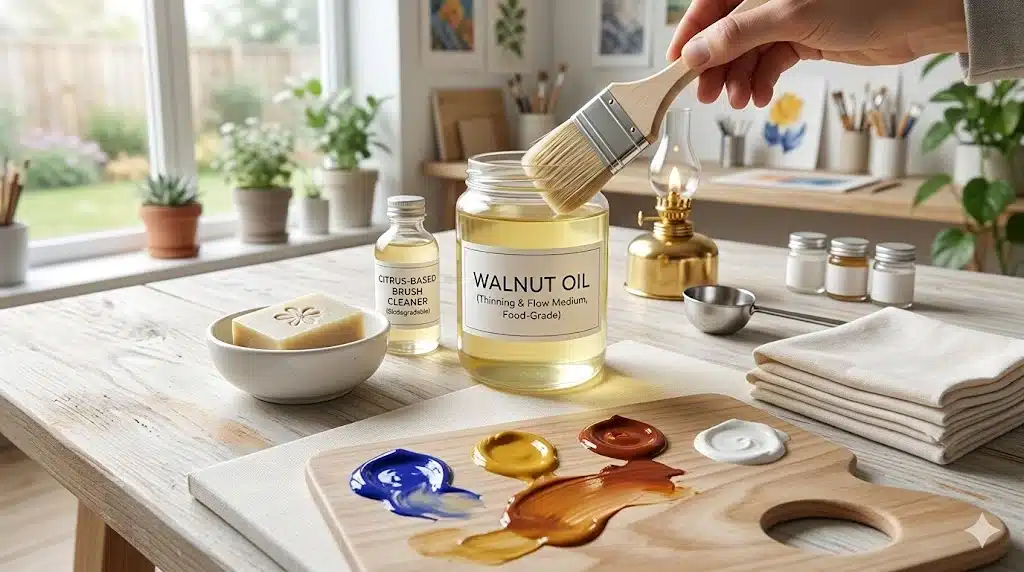
1. Why Build a Non‑Toxic Studio?
For a long time, the smell of turpentine was treated as part of the romance of oil painting. Today, we know better. Traditional solvents like turpentine and strong mineral spirits are effective but also hazardous: they release volatile organic compounds (VOCs) that can irritate your lungs, trigger headaches and migraines, and contribute to long‑term health issues if you paint in them day after day.
Non‑toxic painting advocates and studio safety guides highlight a few key concerns:
- Short‑term effects can include dizziness, nausea, headaches, and respiratory irritation.
- Long‑term exposure can contribute to sensitisation, chronic respiratory problems, and nervous system effects in susceptible individuals.
- Home studios and small rooms are especially risky if ventilation is poor.
- Children, pets, and people with asthma or chemical sensitivities are more vulnerable.
At the same time, you don’t have to give up oil paint to protect your health. Modern materials make it entirely possible to:
- Paint with oils without traditional solvents in the paint layers.
- Clean brushes with oils and soap, not turpentine.
- Or switch to water‑mixable oils that behave like oils but use water instead of solvent for thinning and cleanup.
The goal of the non‑toxic studio is not just swapping one bottle for another; it’s redesigning your workflow and habits so that you can keep painting for decades in a space your body can tolerate.
2. Core Idea: Oil Paint Is Not the Problem—Solvents Are
It helps to separate materials into two categories:
- Oil paint itself: Traditional, artist‑grade oil colors are basically pigment + drying oil (linseed, walnut, safflower, poppy, etc.). These do not inherently require solvent; they can be thinned with more oil or modern mediums and cleaned with soap and oil.
- Solvents and thinners: Turpentine, mineral spirits, and strong petroleum distillates are volatile and produce harmful vapours.
Safer Painting and manufacturer safety pages emphasise this distinction: the main health concern in an oil studio is solvent vapour, not the pigment‑in‑oil paint film you end up with. The non‑toxic studio is about removing or radically reducing solvents while keeping the visual and handling qualities you love.
3. Strategy 1: Solvent‑Free Painting with Modern Mediums
One of the biggest advances in non‑toxic oil painting is the development of solvent‑free alkyd mediums—gels and fluids that thin paint, improve flow, and speed drying without using any solvent at all.
3.1. Solvent‑Free Gel and Fluid Mediums
Gamblin’s Solvent‑Free Gel and Solvent‑Free Fluid are classic examples:
- Made from safflower oil and alkyd resin, with no Gamsol or turpentine.
- Increase flow and transparency, similar to traditional alkyd mediums.
- Promote faster drying than oil alone, often overnight to a couple of days.
- Stay pale in colour because of the safflower base, so they don’t yellow as much as linseed‑rich mixes.
Gamblin’s safety notes explicitly state that their oil colours and these solvent‑free mediums allow you to paint entirely without solvent, using just paint + medium.
Other manufacturers and safety resources echo this approach: solvent‑free alkyd mediums are a key piece of painting safely in shared or small spaces.
3.2. How to use solvent‑free mediums in practice
You can integrate these mediums directly into a normal oil workflow:
- For your block‑in or early layers, use paint straight from the tube or with a small amount of solvent‑free gel/fluid; avoid heavy solvent washes.
- For your middle and upper layers, add more medium for smoother blending, glazing, and increased transparency.
- Respect fat‑over‑lean by using less medium in early layers and more medium in later layers, even though all of it is solvent‑free.
Advantages:
- No solvent cups open on the table.
- Faster drying than plain oil, so you can build layers and finish work in a practical time frame.
- Far fewer fumes, making it workable in a home or school environment.
If you’re used to turpentine or OMS for thinning, the main adaptation is psychological: you reach for gel or fluid instead of a clear solvent.
4. Strategy 2: Traditional Oils with Oils Instead of Solvent
You can also keep using traditional oils and skip solvent entirely.
4.1. Painting with paint + drying oil
The simplest non‑toxic approach is:
- Use paint straight from the tube as your baseline.
- Thin and modify consistency with small amounts of drying oil instead of solvent:
- Linseed oil (classic, strongest film, slightly more yellowing).
- Walnut oil (slower drying, slightly less yellowing).
- Safflower oil (very light but slower and weaker for underlayers).
Instead of starting with a very lean, solventy underpainting, you:
- Either paint your underdrawing with very little medium at all, just slightly scrubbed‑in paint.
- Or use a small amount of fast‑drying oil medium (or solvent‑free alkyd) to keep that first layer lean but still bound by oil, not overwhelmed by solvent.
You still apply fat‑over‑lean logically (less medium early, more later), but you’ve taken solvent out of the equation.
4.2. Natural oils as brush cleaners
Multiple safer‑painting resources and painters who’ve quit solvents describe a standard solvent‑free cleaning routine:
- Wipe the brush thoroughly on a rag or paper towel to remove as much paint as possible.
- Swish the brush in a small jar of drying oil (safflower or walnut are popular), then wipe again.
- Repeat the oil‑swish and wipe until most colour is out.
- Finish with soap and lukewarm water to remove oil and pigment from the bristles.
Key safety notes:
- Only use drying oils (linseed, walnut, safflower). Non‑drying oils (mineral oil, baby oil, many cooking oils) stay sticky and can weaken paint if they migrate into layers.
- Use artist‑grade oils or oils known to dry; store the oil jar covered when not in use.
- Dispose of oil‑soaked rags safely (spread to dry flat, then store in a metal container), as drying oils can self‑heat.
Artists who switched to this method due to health issues frequently report that they no longer need any OMS at all, even for heavy painting days.
5. Strategy 3: Water‑Mixable Oils as a Non‑Toxic System
If you’d rather avoid traditional drying oils and separate mediums, water‑mixable oils offer a self‑contained, low‑toxic system.
5.1. What are water‑mixable oils?
Water‑mixable oils are real oils modified to accept water as a solvent:
- Pigment is still bound in drying oil, but the oil is chemically adjusted so water can mix with it.
- You can thin paint with water for early stages.
- You can clean brushes with soap and water, similar to acrylics.
- Dedicated water‑mixable mediums let you glaze and layer without plain water in later passes.
A demonstration on solvent‑free oil methods shows three routes to painting without solvent, one of which is water‑mixable oils plus their own mediums.
5.2. Pros and cons
Pros:
- No turpentine or OMS needed for painting or cleanup.
- True oil look, especially when you use water‑mixable mediums rather than only water.
- Ideal for shared studios, classrooms, or home environments.
Cons:
- Feel slightly different from traditional oils, especially when heavily thinned with water.
- Best results come from using water in the early stages only and switching to water‑mixable linseed/walnut mediums for later, fatter layers.
If you’re starting from scratch or want the cleanest break from solvents, water‑mixable oils are one of the easiest non‑toxic routes.
6. Strategy 4: If You Must Use Solvent, Use Less and Use It Smarter
Some workflows still rely on a small amount of solvent—often for a very lean first wash. If you’re in that camp, the goal is minimise and ventilate, not go back to open buckets of turpentine.
6.1. Odorless Mineral Spirits (OMS)
OMS is less irritating than raw turpentine but still a petroleum solvent:
- Artist‑grade OMS evaporates completely and leaves no residue if used correctly.
- It still produces VOCs; the lack of smell does not mean it’s harmless.
Studio safety guidelines stress:
- Use small, covered containers—no open dishes evaporating all day.
- Open the jar only when you are actively using it.
- Keep OMS away from heat sources and always close it afterward.
- Ensure active ventilation (see below).
6.2. “Green” or citrus‑based alternatives
Many “natural” or citrus‑based solvents are marketed as safer. Experiences are mixed:
- Some artists like them; others report strong odours or sensitivity.
- A solvent‑free painting guide from a manufacturer warns that many general “eco” thinners do not fully evaporate and can leave oily residues in the paint film, which is not acceptable for archival work.
If you care about longevity:
- Use solvents that either fully evaporate (like artist OMS) or contribute to curing (drying oils/alkyds).
- Avoid adding “home‑made” or untested cleaning products to your paint layers.
For a truly non‑toxic studio, the simplest path is to stop using solvent in paint entirely, and if you retain a bit of OMS, reserve it for occasional brush rescue, with strict ventilation.
7. Building a Safe Workflow: Step‑By‑Step Example
To make this concrete, here is a fully non‑toxic workflow using traditional oils and solvent‑free mediums.
7.1. 1. Set up your space for safety
- Crack a window and, if possible, a door, to create cross‑ventilation.
- Place a fan to blow air toward the open window or out of the room; this moves vapours and odours out instead of just stirring them around.
- Keep food and drinks away from your painting area; wash your hands before eating.
- Even if you’re solvent‑free, pigment dust (if you sand or scrape aggressively) and natural oil odours benefit from fresh air.
7.2. 2. Choose your materials
- Oil paints from a reputable artist brand (no solvent in the tube).
- A solvent‑free gel or fluid medium (alkyd + drying oil).
- Drying oil (linseed or walnut) if you want simplicity instead of gel.
- Safflower or walnut oil for brush cleaning.
- Good brush soap.
- Optional: water‑mixable oils instead, plus their matching mediums if you prefer that route.
7.3. 3. Paint without solvent
Underpainting / block‑in:
- Use paint straight from the tube or with a very small amount of solvent‑free medium or drying oil.
- Scrub in thinly with a bristle brush; you don’t need it to behave like watercolour.
Middle layers:
- Add a modest amount of solvent‑free gel/fluid or oil medium to increase flow and transparency.
- Keep these layers relatively lean compared to your final passes.
Final layers / glazes:
- Use a richer mix of medium and paint (more medium, less or no extra oil cleaners), respecting fat‑over‑lean.
- Keep layers thin but oily enough that they remain flexible and don’t rely on evaporation to dry.
At no point do you need OMS or turpentine to manipulate the paint.
7.4. 4. Clean brushes without turpentine
- Wipe the brush on a rag to remove excess paint.
- Swish in a small jar of safflower or walnut oil, then wipe again.
- Once colour is mostly gone, wash with brush soap and water until the water runs clear.
- Reshape the bristles and let them dry flat or bristles‑down.
- Store oily rags spread flat to dry, then discard them in a sealed metal container to reduce fire risk from spontaneous combustion.
8. Ventilation: The Invisible Non‑Toxic Tool
Removing solvents reduces most acute risks, but ventilation is still part of a responsible studio.
An oil‑painting safety document stresses that even with low‑odour or minimal VOC materials, fresh air helps prevent any vapours from building up, especially in small or windowless rooms. Gamblin’s safety page cites industrial hygienists who recommend multiple air changes per hour in professional settings, and they suggest artists at home approximate this with open windows and fans whenever possible.
Simple practices:
- Do not paint for hours in a sealed room.
- Position yourself so air moves past you and out of the room, not from your painting table toward your face.
- If you use even a little OMS or varnish, ventilate more aggressively during and after use.
- Think of ventilation as a material, just like medium or pigment: something you plan for, not an afterthought.
9. Special Cases: Allergies and Sensitivities
Some artists have nut allergies or specific sensitivities that shape their options. Community and safety discussions highlight a few points:
- If you have nut allergies, avoid walnut oil and check labels of mixed mediums; some contain nut‑derived oils.
- If you are sensitive even to low‑odour OMS, transitioning fully to water‑mixable oils or a solvent‑free system with only drying oils and alkyds is often the best route.
- If you experience migraines or respiratory issues, treat any noticeable smell in the studio as a signal to increase ventilation or reduce exposure time.
In a “Non‑Toxic Studio” framing, the goal is to design around your specific body, not an abstract ideal.
10. Checklist: Designing Your Non‑Toxic Studio
You can wrap the main ideas for your readers like this:
- Remove traditional solvents from your painting layers
- Use solvent‑free gel or fluid mediums.
- Use drying oils (linseed, walnut, safflower) instead of turpentine/OMS.
- Clean brushes with oil and soap, not turps
- Wipe first, then use safflower or walnut oil to loosen paint, then brush soap.
- Consider water‑mixable oils
- Thin with water in early stages, then use water‑mixable mediums, clean up with soap and water.
- If you keep a little OMS, use it sparingly and ventilate
- Small closed jars, only open when in use, never as your primary thinner.
- Ventilate every session
- Open windows/doors, use fans to pull air out, not just swirl it.
- Handle oily rags and waste safely
- Spread to dry, store in metal containers to prevent spontaneous combustion.
Designing a non‑toxic studio is an investment in your long‑term practice. You get to keep all the richness and nuance of oils while taking your body, your home, and your future seriously. For many painters, that shift—from “this is just how it’s always been done” to “this is how I can safely do it for life”—is as transformative as discovering a new colour on the palette.
1. Why Build a Non‑Toxic Studio?
For a long time, the smell of turpentine was treated as part of the romance of oil painting. Today, we know better. Traditional solvents like turpentine and strong mineral spirits are effective but also hazardous: they release volatile organic compounds (VOCs) that can irritate your lungs, trigger headaches and migraines, and contribute to long‑term health issues if you paint in them day after day.
Non‑toxic painting advocates and studio safety guides highlight a few key concerns:
- Short‑term effects can include dizziness, nausea, headaches, and respiratory irritation.
- Long‑term exposure can contribute to sensitisation, chronic respiratory problems, and nervous system effects in susceptible individuals.
- Home studios and small rooms are especially risky if ventilation is poor.
- Children, pets, and people with asthma or chemical sensitivities are more vulnerable.
At the same time, you don’t have to give up oil paint to protect your health. Modern materials make it entirely possible to:
- Paint with oils without traditional solvents in the paint layers.
- Clean brushes with oils and soap, not turpentine.
- Or switch to water‑mixable oils that behave like oils but use water instead of solvent for thinning and cleanup.
The goal of the non‑toxic studio is not just swapping one bottle for another; it’s redesigning your workflow and habits so that you can keep painting for decades in a space your body can tolerate.
2. Core Idea: Oil Paint Is Not the Problem—Solvents Are
It helps to separate materials into two categories:
- Oil paint itself: Traditional, artist‑grade oil colors are basically pigment + drying oil (linseed, walnut, safflower, poppy, etc.). These do not inherently require solvent; they can be thinned with more oil or modern mediums and cleaned with soap and oil.
- Solvents and thinners: Turpentine, mineral spirits, and strong petroleum distillates are volatile and produce harmful vapours.
Safer Painting and manufacturer safety pages emphasise this distinction: the main health concern in an oil studio is solvent vapour, not the pigment‑in‑oil paint film you end up with. The non‑toxic studio is about removing or radically reducing solvents while keeping the visual and handling qualities you love.
3. Strategy 1: Solvent‑Free Painting with Modern Mediums
One of the biggest advances in non‑toxic oil painting is the development of solvent‑free alkyd mediums—gels and fluids that thin paint, improve flow, and speed drying without using any solvent at all.
3.1. Solvent‑Free Gel and Fluid Mediums
Gamblin’s Solvent‑Free Gel and Solvent‑Free Fluid are classic examples:
- Made from safflower oil and alkyd resin, with no Gamsol or turpentine.
- Increase flow and transparency, similar to traditional alkyd mediums.
- Promote faster drying than oil alone, often overnight to a couple of days.
- Stay pale in colour because of the safflower base, so they don’t yellow as much as linseed‑rich mixes.
Gamblin’s safety notes explicitly state that their oil colours and these solvent‑free mediums allow you to paint entirely without solvent, using just paint + medium.
Other manufacturers and safety resources echo this approach: solvent‑free alkyd mediums are a key piece of painting safely in shared or small spaces.
3.2. How to use solvent‑free mediums in practice
You can integrate these mediums directly into a normal oil workflow:
- For your block‑in or early layers, use paint straight from the tube or with a small amount of solvent‑free gel/fluid; avoid heavy solvent washes.
- For your middle and upper layers, add more medium for smoother blending, glazing, and increased transparency.
- Respect fat‑over‑lean by using less medium in early layers and more medium in later layers, even though all of it is solvent‑free.
Advantages:
- No solvent cups open on the table.
- Faster drying than plain oil, so you can build layers and finish work in a practical time frame.
- Far fewer fumes, making it workable in a home or school environment.
If you’re used to turpentine or OMS for thinning, the main adaptation is psychological: you reach for gel or fluid instead of a clear solvent.
4. Strategy 2: Traditional Oils with Oils Instead of Solvent
You can also keep using traditional oils and skip solvent entirely.
4.1. Painting with paint + drying oil
The simplest non‑toxic approach is:
- Use paint straight from the tube as your baseline.
- Thin and modify consistency with small amounts of drying oil instead of solvent:
- Linseed oil (classic, strongest film, slightly more yellowing).
- Walnut oil (slower drying, slightly less yellowing).
- Safflower oil (very light but slower and weaker for underlayers).
Instead of starting with a very lean, solventy underpainting, you:
- Either paint your underdrawing with very little medium at all, just slightly scrubbed‑in paint.
- Or use a small amount of fast‑drying oil medium (or solvent‑free alkyd) to keep that first layer lean but still bound by oil, not overwhelmed by solvent.
You still apply fat‑over‑lean logically (less medium early, more later), but you’ve taken solvent out of the equation.
4.2. Natural oils as brush cleaners
Multiple safer‑painting resources and painters who’ve quit solvents describe a standard solvent‑free cleaning routine:
- Wipe the brush thoroughly on a rag or paper towel to remove as much paint as possible.
- Swish the brush in a small jar of drying oil (safflower or walnut are popular), then wipe again.
- Repeat the oil‑swish and wipe until most colour is out.
- Finish with soap and lukewarm water to remove oil and pigment from the bristles.
Key safety notes:
- Only use drying oils (linseed, walnut, safflower). Non‑drying oils (mineral oil, baby oil, many cooking oils) stay sticky and can weaken paint if they migrate into layers.
- Use artist‑grade oils or oils known to dry; store the oil jar covered when not in use.
- Dispose of oil‑soaked rags safely (spread to dry flat, then store in a metal container), as drying oils can self‑heat.
Artists who switched to this method due to health issues frequently report that they no longer need any OMS at all, even for heavy painting days.
5. Strategy 3: Water‑Mixable Oils as a Non‑Toxic System
If you’d rather avoid traditional drying oils and separate mediums, water‑mixable oils offer a self‑contained, low‑toxic system.
5.1. What are water‑mixable oils?
Water‑mixable oils are real oils modified to accept water as a solvent:
- Pigment is still bound in drying oil, but the oil is chemically adjusted so water can mix with it.
- You can thin paint with water for early stages.
- You can clean brushes with soap and water, similar to acrylics.
- Dedicated water‑mixable mediums let you glaze and layer without plain water in later passes.
A demonstration on solvent‑free oil methods shows three routes to painting without solvent, one of which is water‑mixable oils plus their own mediums.
5.2. Pros and cons
Pros:
- No turpentine or OMS needed for painting or cleanup.
- True oil look, especially when you use water‑mixable mediums rather than only water.
- Ideal for shared studios, classrooms, or home environments.
Cons:
- Feel slightly different from traditional oils, especially when heavily thinned with water.
- Best results come from using water in the early stages only and switching to water‑mixable linseed/walnut mediums for later, fatter layers.
If you’re starting from scratch or want the cleanest break from solvents, water‑mixable oils are one of the easiest non‑toxic routes.
6. Strategy 4: If You Must Use Solvent, Use Less and Use It Smarter
Some workflows still rely on a small amount of solvent—often for a very lean first wash. If you’re in that camp, the goal is minimise and ventilate, not go back to open buckets of turpentine.
6.1. Odorless Mineral Spirits (OMS)
OMS is less irritating than raw turpentine but still a petroleum solvent:
- Artist‑grade OMS evaporates completely and leaves no residue if used correctly.
- It still produces VOCs; the lack of smell does not mean it’s harmless.
Studio safety guidelines stress:
- Use small, covered containers—no open dishes evaporating all day.
- Open the jar only when you are actively using it.
- Keep OMS away from heat sources and always close it afterward.
- Ensure active ventilation (see below).
6.2. “Green” or citrus‑based alternatives
Many “natural” or citrus‑based solvents are marketed as safer. Experiences are mixed:
- Some artists like them; others report strong odours or sensitivity.
- A solvent‑free painting guide from a manufacturer warns that many general “eco” thinners do not fully evaporate and can leave oily residues in the paint film, which is not acceptable for archival work.
If you care about longevity:
- Use solvents that either fully evaporate (like artist OMS) or contribute to curing (drying oils/alkyds).
- Avoid adding “home‑made” or untested cleaning products to your paint layers.
For a truly non‑toxic studio, the simplest path is to stop using solvent in paint entirely, and if you retain a bit of OMS, reserve it for occasional brush rescue, with strict ventilation.
7. Building a Safe Workflow: Step‑By‑Step Example
To make this concrete, here is a fully non‑toxic workflow using traditional oils and solvent‑free mediums.
7.1. 1. Set up your space for safety
- Crack a window and, if possible, a door, to create cross‑ventilation.
- Place a fan to blow air toward the open window or out of the room; this moves vapours and odours out instead of just stirring them around.
- Keep food and drinks away from your painting area; wash your hands before eating.
- Even if you’re solvent‑free, pigment dust (if you sand or scrape aggressively) and natural oil odours benefit from fresh air.
7.2. 2. Choose your materials
- Oil paints from a reputable artist brand (no solvent in the tube).
- A solvent‑free gel or fluid medium (alkyd + drying oil).
- Drying oil (linseed or walnut) if you want simplicity instead of gel.
- Safflower or walnut oil for brush cleaning.
- Good brush soap.
- Optional: water‑mixable oils instead, plus their matching mediums if you prefer that route.
7.3. 3. Paint without solvent
Underpainting / block‑in:
- Use paint straight from the tube or with a very small amount of solvent‑free medium or drying oil.
- Scrub in thinly with a bristle brush; you don’t need it to behave like watercolour.
Middle layers:
- Add a modest amount of solvent‑free gel/fluid or oil medium to increase flow and transparency.
- Keep these layers relatively lean compared to your final passes.
Final layers / glazes:
- Use a richer mix of medium and paint (more medium, less or no extra oil cleaners), respecting fat‑over‑lean.
- Keep layers thin but oily enough that they remain flexible and don’t rely on evaporation to dry.
At no point do you need OMS or turpentine to manipulate the paint.
7.4. 4. Clean brushes without turpentine
- Wipe the brush on a rag to remove excess paint.
- Swish in a small jar of safflower or walnut oil, then wipe again.
- Once colour is mostly gone, wash with brush soap and water until the water runs clear.
- Reshape the bristles and let them dry flat or bristles‑down.
- Store oily rags spread flat to dry, then discard them in a sealed metal container to reduce fire risk from spontaneous combustion.
8. Ventilation: The Invisible Non‑Toxic Tool
Removing solvents reduces most acute risks, but ventilation is still part of a responsible studio.
An oil‑painting safety document stresses that even with low‑odour or minimal VOC materials, fresh air helps prevent any vapours from building up, especially in small or windowless rooms. Gamblin’s safety page cites industrial hygienists who recommend multiple air changes per hour in professional settings, and they suggest artists at home approximate this with open windows and fans whenever possible.
Simple practices:
- Do not paint for hours in a sealed room.
- Position yourself so air moves past you and out of the room, not from your painting table toward your face.
- If you use even a little OMS or varnish, ventilate more aggressively during and after use.
- Think of ventilation as a material, just like medium or pigment: something you plan for, not an afterthought.
9. Special Cases: Allergies and Sensitivities
Some artists have nut allergies or specific sensitivities that shape their options. Community and safety discussions highlight a few points:
- If you have nut allergies, avoid walnut oil and check labels of mixed mediums; some contain nut‑derived oils.
- If you are sensitive even to low‑odour OMS, transitioning fully to water‑mixable oils or a solvent‑free system with only drying oils and alkyds is often the best route.
- If you experience migraines or respiratory issues, treat any noticeable smell in the studio as a signal to increase ventilation or reduce exposure time.
In a “Non‑Toxic Studio” framing, the goal is to design around your specific body, not an abstract ideal.
10. Checklist: Designing Your Non‑Toxic Studio
You can wrap the main ideas for your readers like this:
- Remove traditional solvents from your painting layers
- Use solvent‑free gel or fluid mediums.
- Use drying oils (linseed, walnut, safflower) instead of turpentine/OMS.
- Clean brushes with oil and soap, not turps
- Wipe first, then use safflower or walnut oil to loosen paint, then brush soap.
- Consider water‑mixable oils
- Thin with water in early stages, then use water‑mixable mediums, clean up with soap and water.
- If you keep a little OMS, use it sparingly and ventilate
- Small closed jars, only open when in use, never as your primary thinner.
- Ventilate every session
- Open windows/doors, use fans to pull air out, not just swirl it.
- Handle oily rags and waste safely
- Spread to dry, store in metal containers to prevent spontaneous combustion.
Designing a non‑toxic studio is an investment in your long‑term practice. You get to keep all the richness and nuance of oils while taking your body, your home, and your future seriously. For many painters, that shift—from “this is just how it’s always been done” to “this is how I can safely do it for life”—is as transformative as discovering a new colour on the palette.