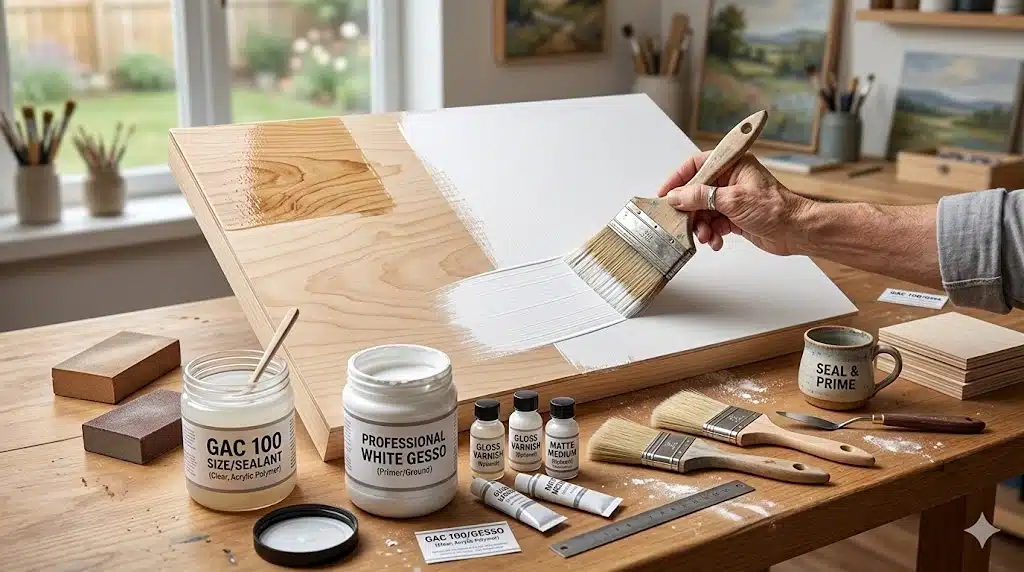
1. Preparation Rituals: Sealing and Grounding Raw Wood for Painting
Raw wood has become a favorite support for many painters—especially those working in acrylics and oils—because it feels solid, modern, and luxuriously “object‑like” on the wall. Cradled birch, basswood, plywood, and hardwood panels are everywhere now. But beneath that clean surface, wood is still a complex, living material.
It’s full of:
- Lignins and tannins that can bleed into your paint layers and cause yellowing.
- Natural oils, resins, and acids that can gradually degrade both acrylic and oil films.
- Moisture, which makes wood expand and contract with humidity.
If you simply brush gesso straight onto a raw panel and start painting, you’re asking that one layer of gesso to do too many jobs: block stains, bond to wood, provide tooth, and stay flexible. That may work for a while, but for long‑term stability and clean color—especially in light areas—you want a more robust, layered approach.
Think of preparing a wood panel as a three‑step ritual:
- Seal – isolate the wood’s chemistry from your painting.
- Prime – build a toothy, light‑reflective ground.
- Level – sand to the exact surface feel that suits your technique.
Once you internalize this workflow, preparing panels becomes second nature—and you’ll immediately notice how much better your paint behaves.
1.1. Why Raw Wood Needs More Than Just Gesso
It’s tempting to treat a wood panel like a chunk of inert Medium Density Fiberboard: a flat thing you can coat with gesso and be done with. The reality is more nuanced.
1.1.1. The chemistry inside the wood
Wood contains a mix of organic compounds that can migrate outward over time:
- Lignin, which can oxidize and darken.
- Tannins, particularly in species like oak, that cause brown staining.
- Water‑soluble extractives, resins, and oils that can move into your ground.
When moisture changes—with seasons, heating, or storage conditions—these compounds become mobile. If there’s no barrier between them and your gesso, they can slowly creep into your ground and paint layers.
1.1.2. Support Induced Discoloration (SID)
In acrylic painting, this migration manifests as Support Induced Discoloration (SID): yellow‑brown stains rising from the support into acrylic grounds and transparent colors.
Panel and paint manufacturers have demonstrated Support Induced Discoloration in tests:
- Panels primed with acrylic gesso directly on wood show visible yellowing in gesso and pale colors over time.
- Identical panels first sealed with an acrylic sealer or gloss medium remain much cleaner, because the sealer locks in wood extractives.
Support Induced Discoloration isn’t a catastrophic failure—you can still make art—but if you care about archival quality and crisp whites, it’s worth preventing.
1.1.3. Oil on wood: different medium, similar concerns
For oil painters, the issues look slightly different:
- Oil can soak into raw wood, leaving underbound, fragile paint films.
- Acidity in wood can interact with drying oils, potentially accelerating embrittlement.
- Unsealed wood can move more with humidity, increasing stress on the brittle oil film.
Historically, traditional oil painters used glue size + gesso or other grounds on wood, recognizing the need to isolate the support. Modern practice often substitutes acrylic sealing and gesso or oil grounds as a more stable and convenient system.
In short: if you want your paintings on wood to age gracefully, a clear barrier plus a solid ground is not overkill—it’s basic care.
1.2. Step 1: Seal – Creating a Barrier with a Clear Acrylic Medium
The first step is sealing, sometimes called “sizing.” This doesn’t mean putting paint on the wood; it means laying down a clear film that locks in the wood chemistry and reduces absorbency.
1.2.1. Why an acrylic sealer?
Modern technical advice for acrylic (and often oil‑over‑acrylic) on wood strongly favors acrylic polymer sealers like Golden Gloss Medium or GAC 100:
- They are pH‑neutral and flexible, suitable for long‑term use on wood.
- They form a continuous film that significantly reduces Support Induced Discoloration.
- They’re easy to brush, non‑toxic when dry, and clean up with water.
While historical methods used animal‑glue size, those glues are brittle and very humidity‑sensitive. Acrylic sealers are more forgiving and stable for today’s studios.
1.2.2. Tools and materials
- Raw wood panel (e.g., birch, basswood, plywood, Medium Density Fiberboard, cradled panel).
- 180–220‑grit sandpaper.
- Golden Gloss Medium or similar gloss acrylic medium/sealer.
- 2–3″ soft synthetic or foam brush.
- Clean cloth for dust.
1.2.3. Step‑by‑step: sealing with Golden Gloss Medium
- Surface prep: Lightly sand the face and edges of the panel with 180–220‑grit sandpaper. You’re just knocking down splinters and raised grain, not reshaping it. Wipe away all dust with a clean, dry cloth. Let the panel dry if you used a slightly damp rag.
- First sealer coat: Pour a bit of Golden Gloss Medium (or similar acrylic gloss sealer) into a small container. With your 2–3″ brush, apply a thin, even coat over the entire front face of the panel, brushing in one direction to avoid puddles. If you’re working with plywood, Medium Density Fiberboard, or cradled panels, it’s good practice to also coat the edges and back. Sealing all sides helps the panel respond more evenly to humidity and reduces warping.
- Dry completely: Lay the panel flat in a dust‑free spot and let it dry thoroughly—at least several hours, or overnight if the environment is cool or humid. The acrylic must coalesce fully into a continuous film; don’t rush this. Do not sand this coat. You want a sealed, unbroken barrier between the wood and later layers.
- Second sealer coat: Apply a second thin coat of Golden Gloss Medium over the same surfaces: front, edges, and back. Again, avoid drips and puddles; you’re aiming for an even, continuous film. Allow this coat to dry completely. Many artists let sealed panels sit overnight before moving on, ensuring the barrier is stable.
1.3. Step 2: Prime – Building Tooth and Ground with Gesso
Now that the wood is isolated, you can add a ground—the layer your paint will actually bond to.
For most contemporary workflows, that means an acrylic gesso suitable for acrylic or oil painting. Traditionalists working only in oils might choose an oil ground or true gesso (chalk + glue), but acrylic gesso is versatile, durable, and easy to use.
1.3.1. What gesso does (and doesn’t do)
Gesso’s core jobs:
- Provide tooth so paint can grip the surface.
- Offer a light, even value (usually white) so color appears clean and consistent.
- Create a slightly absorbent interface tuned to your paint’s behavior.
What gesso does not do well on its own is block all wood extractives. That’s why it comes after the sealer, not instead of it.
1.3.2. How many coats of gesso?
Most manufacturer and panel prep guides recommend at least two coats of gesso, with three or more for a more opaque and even surface. For a fine, ivory‑like ground, three thin coats with sanding between is a solid, professional standard.
1.3.3. Step‑by‑step: priming with acrylic gesso
- First coat of gesso: Once your sealer coats are fully dry, apply a thin, even coat of acrylic gesso to the front of the panel. Use a flat brush or foam roller and try to avoid ridges and drips. If you’re working on a panel that will hang without additional backing (like a cradled panel), it’s good practice to also apply gesso to the back, matching the number of coats front and back to help prevent warping.
- Dry and sand (lightly): Let the first gesso coat dry completely—this can be relatively quick, but don’t rush into sanding. Once dry, lightly sand with 220‑grit sandpaper. You’re just knocking down brush marks and any raised fibers, not removing the layer. Wipe away all dust with a clean cloth.
- Second coat of gesso: Apply a second thin coat of gesso, this time brushing in a different direction (e.g., vertical for the first coat, horizontal for the second) to help even out any residual texture. Let it dry fully and lightly sand again with 220‑grit. Clean off the dust as before.
- Third coat of gesso: For most fine art use, a third thin coat completes a strong, unified ground. Apply it as before, aiming for thin, even coverage. After it dries, you can either: Leave it as is if you like a bit of tooth, or Sand again (see next step) to refine the surface further.
1.4. Step 3: Level – Sanding to Your Ideal Surface Feel
“Leveling” is a fancy way of saying sanding to taste. Once your gesso layers are down, you decide whether you want:
- A slightly toothy surface with some drag, ideal for expressive brushwork and visible strokes.
- A very smooth, almost ivory‑like surface that’s perfect for fine detail, glazing, or tight realism.
1.4.1. Sanding options and grit
Between earlier coats, 220‑grit sandpaper strikes a good balance: it removes ridges but doesn’t quickly cut through layers.
For your final sanding:
- Move to 320–400 grit if you want a noticeably finer surface.
- Some artists go even finer (600+ grit) for hyper‑smooth grounds, particularly for detailed work or airbrush techniques.
Regardless of grit:
- Sand gently and evenly, checking often; you don’t want to expose the sealer or wood.
- Always remove dust before painting or applying any additional layers.
1.4.2. Choosing your finish
Ask yourself how you like paint to feel:
- If you like a bit of resistance, stop sanding once the major peaks are removed and the surface feels satin‑smooth but still has tooth.
- If you prefer a skating, enamel‑like feel, continue with finer grits until the panel feels nearly as smooth as illustration board.
There’s no single correct answer—this is where your personal preference and painting style dictate the final step.
1.5. Avoiding Common Problems When Prepping Wood Panels
Even with a solid workflow, a few issues can creep in. Here’s how to troubleshoot.
1.5.1. Yellowing or staining in light areas
- Cause: Usually Support Induced Discoloration from insufficient sealing or wood with high tannins.
- Fix for next time: Use two solid coats of an acrylic sealer like Golden Gloss Medium, front and back. Allow full drying before gesso. Avoid relying on gesso alone to block staining.
- For panels already showing mild staining: Apply an additional sealing coat over the discolored gesso, then re‑gesso; or embrace the warmer ground and adjust your palette accordingly.
1.5.2. Warping or cupping
- Cause: Typically uneven coating—e.g., multiple coats on the front, nothing or less on the back—or environmental swings.
- Prevention: Seal and prime both sides of the panel (and edges) with the same number of coats. Store panels flat or vertically supported in a stable environment.
- Note: Minor warping sometimes relaxes over time; more severe issues may require mechanical correction or replacement.
1.5.3. Over‑sanding through to wood
- Cause: You accidentally sand through your gesso and sealer.
- Signal: You see raw wood or a darker patch.
- Fix: Spot‑seal the exposed wood with Golden Gloss Medium. Let dry fully. Re‑gesso that area and feather into surrounding ground, then re‑sand lightly. Avoid aggressive sanding pressure; many light passes are safer than one heavy one.
1.6. Quick Reference: Professional Wood Panel Prep Checklist
| Step | Action Items |
|---|
| 1. Seal (Golden Gloss Medium or similar) | Lightly sand raw wood (180–220 grit), wipe dust. Apply 1st thin coat of Golden Gloss Medium front, edges, back. Dry thoroughly. Apply 2nd thin coat front, edges, back. Dry thoroughly. Don’t sand between sealer coats. |
| 2. Prime (Acrylic gesso) | Apply 1st thin coat of gesso to front (and back if panel), dry, sand with 220 grit. Apply 2nd thin coat, dry, sand. Apply 3rd thin coat, dry. Sand again if desired. |
| 3. Level (Surface tuning) | Final sanding with 220 → 320–400 grit, depending on desired smoothness. Wipe dust. Panel is ready for acrylic or oil painting. |
1.7. Turning a Ritual into a Habit
The first time you go through this process, it can feel like a lot of steps: sanding, sealing twice, three coats of gesso, multiple rounds of sanding. But after a couple of panels, it becomes a predictable ritual:
- Seal to protect the painting from the wood.
- Prime to create a reliable ground.
- Level to create a surface that feels right under your brush.
In return, you get panels that:
- Don’t surprise you with strange yellow patches.
- Warp less in changing seasons.
- Let your colors sit cleanly, with predictable absorbency and tooth.
Once you’ve experienced how much nicer it is to paint on a properly prepared panel, “gesso straight on wood” will feel like skipping steps in the worst way—you’ll know your painting deserves better.