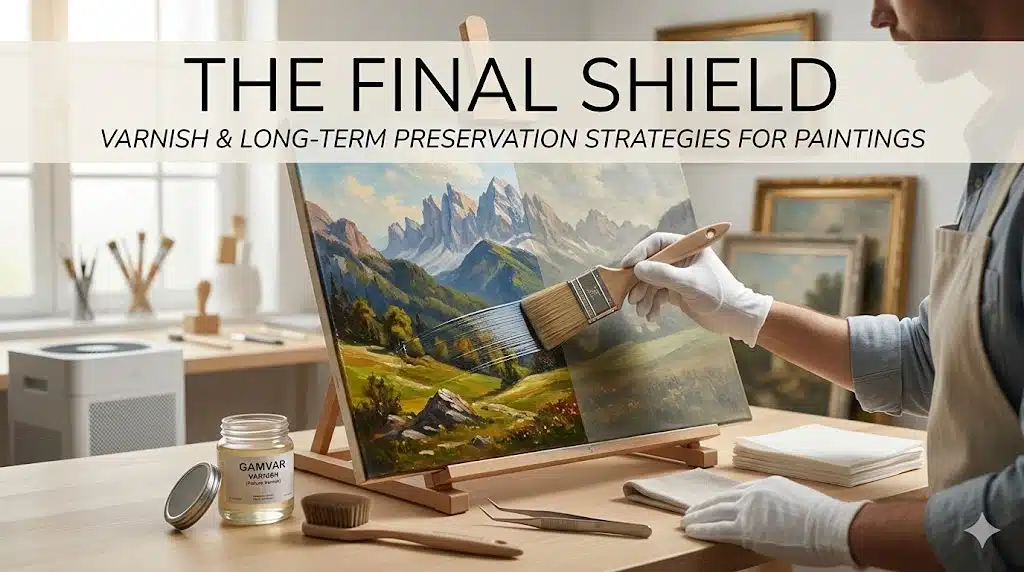
1. The Final Shield: Why Varnish Matters for Long‑Term Preservation
When you sign a painting, it might feel finished—but from a conservation perspective, there’s one more critical step: varnish. This clear, final layer is your painting’s “final shield”: a sacrificial, removable skin that takes the hits from dust, grime, and light so your actual paint layer doesn’t have to.
Museum and conservation sources describe varnish as playing a dual role: it influences the overall appearance of the painting and serves as a protective coating for the paint surface. Without a proper varnish, your painting remains more vulnerable to environmental damage over time—even once the paint itself has fully cured.
In this guide, we’ll look at:
- What varnish actually does (and why it’s sacrificial).
- How it unifies sheen and restores saturation.
- When and how to varnish oils and acrylics.
- The differences between gloss, satin, and matte.
- Long‑term preservation strategies that begin with this final shield.
2. What Varnish Actually Is (and Isn’t)
A true picture varnish is a separate, transparent film applied over a fully dry or cured painting. It should remain distinct from the paint below so that conservators can remove it later without disturbing the original artwork.
2.1. Core functions of a varnish
2.1.1. Protection from dirt and handling
Over years, airborne dust, smoke, kitchen vapors, skin oils, and other grime settle onto paintings. Varnish:
- Catches that dirt in its own surface.
- Provides a layer that can be cleaned or replaced, instead of cleaning the paint directly.
2.1.2. Protection from light (with UV‑protective types)
Many modern artist varnishes include UV light stabilisers or absorbers, which help slow the fading of light‑sensitive pigments under normal lighting conditions. This doesn’t replace the need for lightfast pigments or sensible display, but it adds a layer of defense.
2.1.3. Visual unification
Varnish significantly affects how a painting looks by:
- Evening out surface gloss, so you don’t have random matte and glossy patches.
- Restoring color depth and contrast lost to “sinking in” or uneven drying.
2.1.4. Removability for conservation
High‑quality artist varnish is designed to be reversible with specific solvents, even after aging. This allows conservators to:
- Remove yellowed or dirty varnish.
- Clean the surface safely.
- Re‑apply fresh varnish, extending the painting’s life.
2.2. What varnish is not
- It is not a substitute for good materials or technique (e.g., it can’t fix brittle paint applied over poor grounds).
- It is not always mandatory for every acrylic painting—some artists intentionally leave acrylic unvarnished and instead rely on an isolation coat for a wipeable surface.
- It is not automatically safe to apply whenever the surface feels dry; timing matters, especially for oils.
3. Varnish as a Sacrificial Bodyguard
One of the most important ideas in conservation is that varnish is sacrificial. It’s expected to age, yellow slightly (depending on type), attract dirt, and eventually be removed.
Museum conservation institutes describe the varnish layer as a protective coating that can be taken off and replaced when it becomes discoloured or obscuring. A recent scientific study even focused on visualising varnish removal with advanced imaging, underlining how central this step is to conservation work.
Because varnish is designed to be softer and more soluble than the paint layer, conservators can:
- Test solvents that will dissolve the varnish but leave the paint intact.
- Monitor removal (traditionally under UV light; increasingly with advanced imaging) to ensure they stop before reaching the paint.
- Re‑varnish with a fresh, clear protective coat.
This is why artists are advised to use artist‑grade, removable varnishes, not generic hardware finishes. The long‑term goal is always reversibility.
4. Aesthetic Role: Unifying Sheen and Fixing “Sinking In”
Even if you weren’t concerned about long‑term preservation, varnish still has major visual benefits.
4.1. Irregular gloss and “sinking in”
Oil paintings especially—and sometimes acrylics—often dry unevenly:
- Some areas dry matte and chalky, where the binder has sunk into an absorbent ground or earlier layer.
- Other areas remain glossy and rich, especially dark, oily passages.
This irregular gloss can make a painting look patchy and unfinished. Natural Pigments and other technical sources describe this as an “irregular gloss” problem common in oil paint and varnish films.
4.2. How varnish restores unity and depth
A proper final varnish:
- Unifies the surface sheen, giving the painting a consistent gloss, satin, or matte finish from corner to corner.
- Re‑saturates sunken colours, especially in dark areas, by adjusting surface reflectance and allowing more light to penetrate and reflect back from pigment particles.
Artists are often surprised at how dramatically a painting “comes to life” once varnished properly: colours deepen, darks regain richness, and subtle transitions become more visible.
5. Gloss, Satin, or Matte: Choosing Your Final Look
Most varnish lines come in at least three finishes: gloss, satin, and matte. Each has a distinct visual effect and practical trade‑offs.
| Varnish Finish | Characteristics and Visual Effect |
|---|
| Gloss Varnish | Provides maximum color saturation and depth. Strong reflections and glare. Makes dark paintings look richer. Often the “purest” without matting agents. |
| Satin Varnish | A middle ground with a gentle sheen. Enhances color without high glare. Widely preferred by acrylic painters as a “happy medium.” |
| Matte Varnish | Provides a flat, non-reflective surface. Minimal glare, but slightly mutes color and dark tones. Highest level of matting agents. |
Mixing finishes: You can often mix gloss and matte varnishes to create a custom satin finish, following manufacturer ratios and mixing thoroughly. This flexibility lets you fine‑tune the final sheen to your preference.
6. Timing: When Is It Safe to Varnish?
Timing is crucial. Varnishing too early can cause serious issues: adhesion problems, wrinkling, or a varnish film that fuses with an uncured paint layer and is no longer removable.
6.1. Oil paintings
Oil paints cure slowly by oxidation. Best practice guides give this advice:
- Standard rule: Wait 6–12 months after completion before applying a final varnish to oils.
- Thick, impasto paintings or humid environments may require even longer.
- You can test readiness by gently rubbing an inconspicuous area with a cotton swab dipped in low‑odor mineral spirits; if no colour lifts, the surface is likely sufficiently cured to varnish.
Applying varnish too early can cause the varnish to meld with the still‑drying paint and increase the risk of cracking or wrinkling as oils continue to cure.
6.2. Acrylic paintings
Acrylics dry mainly by water evaporation and film coalescence, which is much faster:
- Many sources recommend waiting at least 7 days for thin acrylic paintings, and longer for thicker or heavily medium‑rich works.
- Manufacturer‑specific recommendations vary; some suggest 1–2 weeks for complete curing before varnishing.
- An acrylic painting might feel touch‑dry quickly, but varnishing too early can trap moisture and lead to cloudiness.
7. Isolation Coats for Acrylic: A Hidden Safeguard
For acrylic paintings, professionals often add an isolation coat between the painting and the removable varnish.
7.1. What is an isolation coat?
An isolation coat is a clear acrylic medium layer applied over the fully dry painting before varnish:
- Usually a gloss or soft gel medium thinned according to manufacturer instructions.
- Forms a durable, non‑removable barrier that separates the paint from the varnish.
7.2. Why it matters for long‑term preservation
Without an isolation coat, removing varnish risks interacting directly with the paint. With an isolation coat, the varnish can be removed to that interface, leaving both paint and isolation coat intact. You get a more robust, conservation‑friendly system for long‑term care.
8. Step‑by‑Step: Varnishing Acrylic Paintings for Preservation
Here’s a simplified, archival‑minded workflow based on best‑practice guides.
- 1. Allow full drying: Let the acrylic painting dry at least a week (or longer for thick work).
- 2. Apply an isolation coat: Mix a gloss acrylic medium. Lay painting flat. Apply a thin, even coat with a soft, wide brush. Let dry 24 hours or more.
- 3. Choose your varnish: Decide on finish. Choose a removable artist varnish formulated for acrylic (solvent-based or specialized UVLS).
- 4. Apply varnish: Lay flat. Use a dedicated varnish brush for a thin, even coat. Let dry fully (24 hours) before a second coat.
9. Step‑by‑Step: Varnishing Oil Paintings for Longevity
For oils, timing and solvent strength are especially important.
- 1. Confirm the painting is cured enough: Wait at least 6 months. Use the cotton‑swab test with a low-odor solvent.
- 2. Light surface cleaning: Gently remove loose dust with a soft, clean brush. Avoid water.
- 3. Choose a picture varnish: Select an artist‑grade, removable varnish designed for oil paintings (e.g., stable synthetic resins).
- 4. Apply varnish: Work in a dust-free space. Lay flat. Apply a thin, even coat in one direction. Let dry 24 hours or more before handling.
10. Long‑Term Care and Preservation Strategies
Varnishing is just one part of preserving paintings. For truly long‑term care, consider:
10.1. Document your varnish choice
Write the name and type of varnish on the back edge of your painting. This helps future conservators know exactly what was used and which solvent to select for safe removal.
10.2. Control display conditions
- Avoid direct, strong sunlight.
- Keep paintings away from heat sources and damp environments.
- Use UV‑filtering glass or acrylic if framing sensitive works.
10.3. Dust gently
Dust occasionally with a soft, dry brush or microfiber cloth. Avoid cleaning sprays, water, or household detergents on varnished surfaces.
10.4. Plan for future re‑varnishing
Over decades, varnish layers may yellow or accumulate dirt; having used a removable artist varnish means the painting can be cleaned and re‑varnished without disturbing the paint.
11. Quick Reference: The Final Shield Checklist
| Action | Requirement |
|---|
| Use the right varnish | Choose artist‑grade, removable varnish. Avoid hardware store finishes. |
| Wait long enough | Oils: 6–12 months. Acrylics: 7 days to 2 weeks. |
| Add an isolation coat | For acrylics, apply a clear medium layer before removable varnish. |
| Apply thin layers | Use a soft brush, work in one direction, avoid over‑brushing. |
Varnish is more than just a shiny topcoat. When chosen and applied thoughtfully, it is a deliberate conservation strategy—a transparent, sacrificial shield that protects your paintings now and makes it possible for others to care for them in the future.