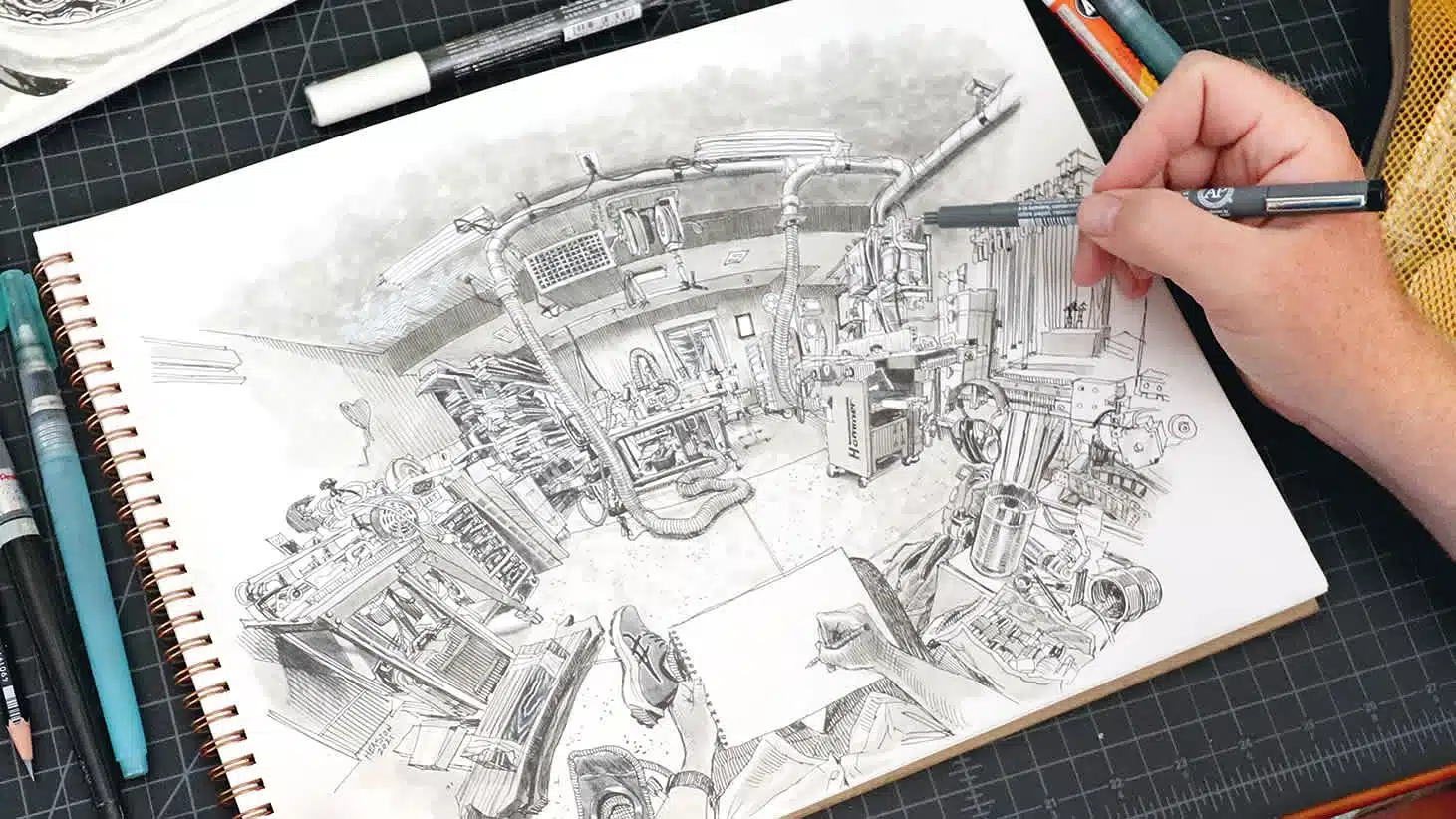
Perspective Foundations: A Guide to 1-, 2-, and 3-Point Perspective
Art Team
June 7th, 2026
No Comments
Perspective Drawing Guide
Introduction: Seeing Space Like an Artist
Perspective is one of the most transformative skills an artist can master. It bridges the gap between a flat surface and the illusion of three-dimensional space, allowing drawings to feel solid, believable, and alive. Yet, for many beginners, perspective can seem intimidating — a set of rigid math-like rules that drain creativity.
The truth is nearly the opposite. Perspective gives you the language to express spatial ideas freely. Once understood, it becomes a dynamic tool, not a constraint. Whether your subject is an architectural street scene, a still life, or an imaginative concept, perspective ensures coherence — the logic that convinces your viewer that lines, shapes, and shadows belong together in space.
This guide will demystify the foundations of 1-point, 2-point, and 3-point perspective, blending classical theory with practical exercises that you can apply to any medium or style.
I. The Foundations of Perspective
1. What Is Perspective Drawing?
At its core, perspective is a way to represent three-dimensional space on a two-dimensional surface. It mimics how the human eye perceives depth: objects appear smaller as they move farther away, parallel lines converge, and angles shift based on viewpoint.
The invention of linear perspective in Western art is credited to Italian Renaissance architect Filippo Brunelleschi in the early 15th century. By mathematically aligning visual elements to an imaginary “horizon line” and “vanishing point,” Brunelleschi demonstrated that realistic spatial illusions could be systematically constructed — a revolution that transformed painting, sculpture, and architecture forever.
Today, every representational artist relies on those same principles, whether consciously or intuitively.
2. Key Vocabulary: Building Your Visual Grammar
Understanding a few essential terms will simplify everything that follows:
Horizon line: Represents the viewer’s eye level. Everything moves relative to it.
Vanishing point(s): The spot(s) on the horizon line where parallel lines appear to converge.
Orthogonals: Diagonal lines that lead toward a vanishing point.
Transversals: Lines that remain parallel to the picture plane (e.g., the top and bottom edges of a window in a front-facing building).
Station point: The location of the viewer’s eyes or “camera” — your position in space relative to the subject.
3. The Vision Behind Perspective: How the Eye Sees
Human vision naturally distorts parallel lines. For instance, train tracks appear to meet at the horizon even though we know they remain constant in width. This phenomenon arises from the geometry of sight — light rays travel from multiple points on a scene to a single point in the eye. Perspective drawing simply formalizes that natural phenomenon on paper.
II. Mastering the Three Systems
1. 1-Point Perspective: Facing the Scene Head-On
1-point perspective is used when your viewpoint faces one set of parallel lines head-on — for instance, standing in front of a building or looking down a straight hallway. All depth lines converge toward a single vanishing point on the horizon line.
Step-by-Step Construction:
Draw a horizon line across your paper — decide your eye level (high, middle, or low).
Place a vanishing point somewhere along that line.
Sketch a rectangle to represent the front plane of a box or room.
From each of the rectangle’s corners, draw lines back toward the vanishing point — these are your orthogonals.
Add a second rectangle behind the first to close the box, using horizontal and vertical lines parallel to the front.
2. 2-Point Perspective: Turning the Corner
2-point perspective appears whenever the viewer sees an edge of an object — neither flat frontal nor extreme bird’s-eye. If you stand at a building’s corner and look diagonally across two facades, each side recedes toward its own vanishing point on the horizon line.
Step-by-Step Construction:
Begin with a horizon line spanning your page.
Place two vanishing points on that line, usually wide apart for natural proportion.
Draw a vertical line between them to represent a building’s corner.
From the top and bottom of that line, connect edges to both vanishing points.
Add verticals to complete facades. You now have a cube that appears turned in space.
3. 3-Point Perspective: Embodying the Dramatic View
3-point perspective adds a third vanishing point, introducing vertical depth. It’s used when looking sharply up (worm’s-eye) or down (bird’s-eye) at tall structures. The verticals no longer stay parallel — they now converge, giving monumental scale and energy.
Step-by-Step Method:
Start with your horizon line and two lateral vanishing points as in 2-point perspective.
Add a third vanishing point above (for worm’s-eye) or below (for bird’s-eye) the horizon line.
Draw an initial vertical line representing the building’s corner, then connect its top and bottom to the top/bottom vanishing points.
Build outward to shape forms, always checking convergence toward all three points.
4. Comparing the Three Systems
Type of Perspective
Number of Vanishing Points
Typical View
Emotional Effect
1-Point
1
Front-on
Calm, centered, balanced
2-Point
2
Corner view
Natural, dynamic, realistic
3-Point
3
High/low angle
Dramatic, monumental, immersive
III. Compositional Strategy and Control
1. Establishing Control Over the Horizon Line
Low horizon line: Emphasizes height and grandeur (useful when portraying tall trees or mountains).
Mid horizon line: Feels stable and neutral — common in everyday scenes.
High horizon line: Suggests a bird’s-eye vantage, useful for layouts or crowd scenes.
2. Perspective and Composition: Guiding the Viewer’s Eye
Perspective isn’t just technical — it’s compositional. Vanishing points naturally direct attention. Smart designers align key focal areas with those implied paths. Rule of thumb: If lines lead the eye inward, balance them with contrasting diagonals, figures, or color accents to prevent tunnel vision and maintain rhythm.
3. Beyond the Grid: Atmospheric and Curvilinear Perspective
Linear perspective handles geometry; atmospheric perspective handles mood. As distance increases, edges soften, contrast fades, and colors cool. More advanced artists also explore curvilinear or 5-point perspective, useful for panoramic or fisheye compositions. These systems bend straight orthogonals into arcs, replicating wide-lens distortion.
4. Perspective as Storytelling
Perspective determines emotional engagement as much as structure. Low angles empower subjects; high angles diminish them. A centered viewpoint invites contemplation; an oblique one suggests tension or motion. Before sketching, ask: Where do I want my viewer to stand emotionally?
IV. Advanced Application and Refinement
1. Integrating Figures and Objects in Space
A simple hack: draw a ground line parallel to the horizon. All figures of equal height along that plane should reach the same point relative to the horizon — for example, eye level. This method aligns crowds naturally without measuring grids for each.
2. Perspective in Color and Value
Though perspective starts with line, it extends to tone and color. Value contrast diminishes with depth — foregrounds high in contrast, backgrounds muted. Similarly, color temperature cools as distance increases.
3. Common Mistakes (and How to Fix Them)
Vanishing points too close: Causes unnatural distortion. Move them farther apart.
Misaligned figures or doors: Measure verticals against the horizon to keep them straight.
Overuse of ruler stiffness: Relax linework with organic variation and line weight after construction.
4. Digital Perspective: Modern Tools
Digital art software like Photoshop, Procreate, or Blender includes perspective grids. Tips for digital workflow: Create a custom perspective guide layer; Use “snap to vanishing point” tools sparingly; Rotate the canvas to mimic natural wrist motion.
V. Practice and Mastery Path
1. Practical Exercises to Build Mastery
Exercise 1: Simple Boxes Everywhere – Scatter cubes randomly across a page.
Exercise 2: The Corridor Challenge – Draw an interior hallway in 1-point perspective.
Exercise 3: City Corner in 2-Point – Construct a corner scene with storefronts and sidewalks.
Exercise 4: Worm’s-Eye Architecture – Try a 3-point view looking up at skyscrapers.
Exercise 5: Imagination to Reality – Invent a fantasy structure using correct perspective rules.
2. Growth Path: From Exercises to Expression
Month 1: Practice 1-point perspective interiors and corridors.
Month 2: Transition to street corners in 2-point setup.
Month 3: Experiment with 3-point aerial views.
Month 4: Apply skills to imaginative landscapes or narrative illustrations.
Struggling to blend acrylics before they dry? Learn wet-on-wet, wet-on-dry, glazing, brush and medium choices, drying-time tricks, and step-by-step exercises for smoother blends.
Confused by acrylic mediums? Learn what gels, fluids, retarders, and other additives actually do, how brands differ, and which ones are genuinely useful for your painting style.
Learn how to transform your sketches into expressive watercolor paintings. Covers planning, transferring drawings, line work, layering, and finishing techniques for artists at any level
Learn the core principles of perspective drawing with clear explanations, visual logic, and practical steps to create convincing spatial depth in your art.
Turn your love of animals into a professional pet portrait business. Learn how to paint convincing eyes and fur, tell emotional “pet stories,” market your work, and use certificates of…
Learn how to properly seal and prime raw wood panels for acrylic and oil painting. Step‑by‑step instructions on using Golden Gloss Medium, applying gesso, sanding, and preventing yellowing and warping.
Want the feel of canvas with the stability of a panel? Learn how to mount canvas or linen to wood boards using archival adhesives, avoid bubbles, and prevent cracking in…
Struggling to pick between watercolor, acrylic, or oil? Learn how drying time, control, and personality traits like patience and pace determine which paint medium is the best fit for you.