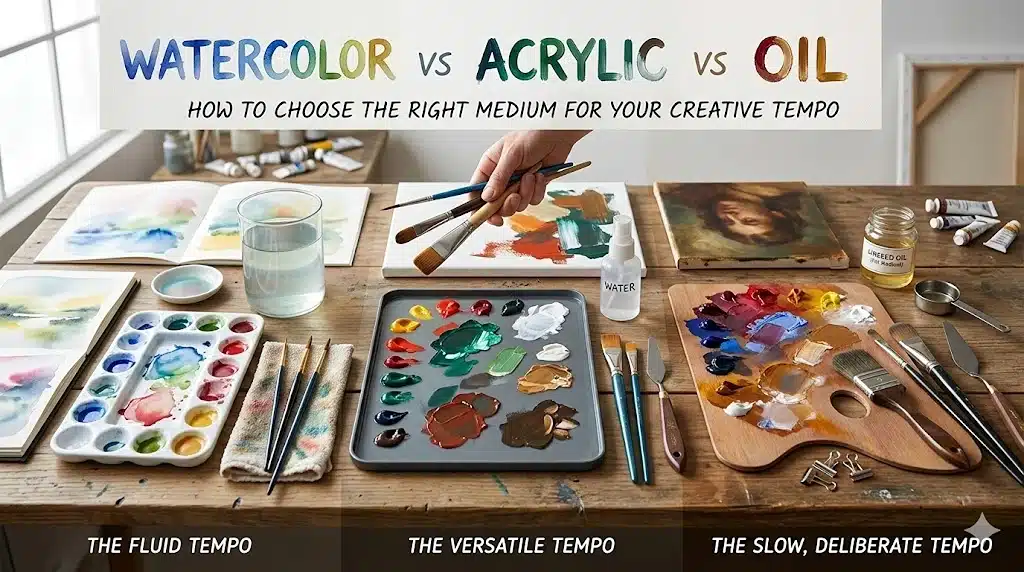
1. Finding Your Flow: Matching Your Medium to Your Natural Pace
Some artists think fast and paint fast; others like to build an image slowly over days. Your artistic tempo—how quickly you like to decide, how long you enjoy staying with one passage, and how much unpredictability you tolerate—matters more than you might realize when picking a medium.
Watercolor, acrylic, and oil differ in drying time, reworkability, and how they respond once they’re on the surface. If you choose a paint that fights your natural pace, you’ll feel blocked for reasons that have nothing to do with talent and everything to do with chemistry.
1.1. Watercolor: For the Responsive, Quick-Deciding Artist
Watercolor is pigment bound with a water‑soluble gum (usually gum arabic) that reactivates with water. It’s fast, transparent, and slightly unpredictable in ways many artists find addictive.
1.1.1. How watercolor behaves
- Dries quickly: thin washes often dry within minutes.
- Reactivates with water: you can list and soften, but you can also unintentionally disturb earlier layers.
- Works light to dark: you preserve white paper for highlights and build shadows gradually.
- High transparency: underlying layers and paper glow through each wash.
1.1.2. Who watercolor is best for
Watercolor tends to suit artists who:
- Enjoy “happy accidents” like blooms and backruns and can work with them instead of against them.
- Prefer short, focused sessions where a piece can reach a satisfying stopping point quickly.
- Are comfortable planning light areas early and accepting that some decisions can’t be fully undone.
If you like your sessions to feel quick, fresh, and responsive, watercolor matches that tempo well.
1.1.3. Pros
- Very portable, minimal setup and cleanup—just water and a small palette.
- Great for sketchbooks, travel painting, and daily studies.
- Encourages loose, expressive mark‑making and sensitivity to value.
1.1.4. Cons
- Dark mistakes are hard to fully correct; pure whites are precious.
- Requires good paper and some planning to shine.
- Colors dry lighter than they look wet, which can surprise beginners.
1.2. Acrylic: For the Fast Builder and Experimenter
Acrylics are pigment in an acrylic polymer emulsion—essentially liquid plastic that forms a flexible, waterproof film when dry. They are versatile and highly forgiving for iterative painters.
1.2.1. How acrylic behaves
- Dries quickly: thin layers can be touch‑dry in minutes, ready for the next pass.
- Permanent once dry: you can’t re‑wet and re‑blend; you paint over it instead.
- Flexible look: can mimic watercolor when thinned, or oil‑like impasto when used thick.
1.2.2. Who acrylic is best for
Acrylics reward artists who:
- Like to work fast, try ideas, and repaint or cover what doesn’t work.
- Enjoy mixed media work—collage, ink, pencil, pastel—on top of dry paint.
- Prefer a modern, graphic feel or strong shapes and layers.
If you think in rapid iterations—try, adjust, paint over—acrylics echo that experimental tempo.
1.2.3. Pros
- Fast layering: you can build complex paintings in a single day without waiting for long drying times.
- Easy correction: mistakes can be covered once dry.
- Water cleanup and low fumes compared to traditional oils.
1.2.4. Cons
- Short wet‑blending window without slow‑dry mediums.
- Colors can shift slightly darker or less glossy when dry.
- Thick textures are permanent; you can cover the color, not the bump.
1.3. Oil: For the Slow, Sculptural, Reflective Painter
Oil paint suspends pigment in drying oils such as linseed, walnut, or safflower. These oils cure slowly, giving oils their legendary blendability and depth.
1.3.1. How oil behaves
- Slow drying: surface can stay workable for hours or days; full curing takes weeks or longer.
- Buttery, long-working texture: high‑quality oils feel smooth and responsive under the brush.
- Rich, luminous color: oils excel at deep saturation and subtle value shifts.
- Strong, flexible film: when used properly, oil layers can remain stable for centuries.
1.3.2. Who oil is best for
Oils suit artists who:
- Enjoy reworking and refining over multiple sessions.
- Want maximum time to blend and adjust edges.
- Like building paintings through underpainting, scumbling, and glazing.
If your natural tempo is reflective and you value long, quiet work sessions with a single piece, oil supports that rhythm better than any other medium.
1.3.3. Pros
- Very long blending window, ideal for subtle transitions and realism.
- Deep color and layered optical effects with glazes.
- Highly responsive to nuanced brushwork and textural variation.
1.3.4. Cons
- Requires patience and planning; you often work over days, not minutes.
- More involved setup and cleanup, usually with some form of solvent.
- Technical considerations like fat over lean and medium choice add complexity.
1.4. Comparison Table: Water vs Plastic vs Oil
| Aspect | Watercolor (Water) | Acrylic (Plastic) | Oil (Oil) |
|---|
| Drying speed | Fast; minutes for washes | Fast; minutes to touch-dry | Slow; hours–days surface-dry |
| Reworkability | Reactivates with water | Not reworkable once dry | Adjustable while wet; layerable when dry |
| Typical value direction | Light → dark | Flexible, often dark → light | Often dark → light with glazes |
| Transparency / opacity | Naturally transparent | Both transparent and opaque | Wide range, great glazes |
| Ease of correction | Hard to undo darks | Easy to cover once dry | Moderate; scrape or overpaint |
| Setup / cleanup | Easiest; water only | Soap and water; clean before dry | Needs more care; often solvents |
| Best-fit temperament | Quick, responsive, accepts chance | Fast, iterative, likes to rebuild | Slow, reflective, enjoys long blending |
1.5. Mini Quiz: Which Medium Suits Your Tempo?
You can drop this as a call‑out box or sidebar.
1.5.1. Question 1
You sit down to paint and realize you don’t like the composition. You want to:
- A. Start over on a fresh sheet and keep it loose.
- B. Paint right over it and fix it in the next layer.
- C. Rework the existing layer, nudging and blending until it feels right.
1.5.2. Question 2
You’re happiest when:
- A. The paint surprises you and does things you didn’t plan.
- B. You can see big progress in a single session, even if you redo sections three times.
- C. You can sink into one section for hours, finessing subtle transitions.
1.5.3. Question 3
Drying time:
- A. I like it fast; I want to flip pages and move on.
- B. I want it fast enough to keep building, but not so fast I can never blend.
- C. I want it slow; give me hours of workable time.
1.5.4. Results
Mostly A’s → Watercolor (“Water”)
You like responsiveness and spontaneity. Watercolor’s speed and flow will match your energy—just be ready to plan your lights and accept a few surprises.
Mostly B’s → Acrylic (“Plastic”)
You’re an iterative builder. Acrylic lets you work quickly, correct often, and mix in other media as you go. It’s perfect if you like to see clear progress every session.
Mostly C’s → Oil (“Oil”)
You’re a slow sculptor of paint. Oils give you the long working time and rich surface you crave, at the price of more setup, cleanup, and patience.
1.6. How to Test All Three in Practice
If you’re still unsure, try this simple three‑day experiment:
Pick one simple subject—a mug, a single apple, or a basic landscape.
1.6.1. Day 1: Watercolor (30–45 minutes)
- Paint it with light washes and minimal corrections.
- Note how the speed and unpredictability feel.
1.6.2. Day 2: Acrylic (60–90 minutes)
- Paint, then repaint right over any parts you dislike.
- See how fast layering and corrections feel in your body.
1.6.3. Day 3: Oil (two or three short sessions)
- Block in, then return later to blend and refine the same areas.
- Notice whether the long working time feels freeing or slow.
1.6.4. Reflection
After three days, ask:
- When did I feel most “in sync” with the paint?
- When did time fly instead of dragging?
- Which medium’s frustrations felt worth pushing through?
Your honest answers will tell you more than any theory.
1.7. You Don’t Have to Choose Just One
Many artists end up with a “primary” medium and one or two supporting roles:
- Watercolor for sketchbooks and travel.
- Acrylic for large, fast, or mixed‑media projects.
- Oil for slow, ambitious or highly rendered pieces.
Think of water, plastic, and oil as three different speeds available to you. Once you know your natural tempo, you can:
- Pick the medium that supports it most of the time.
- Deliberately switch mediums when you want to stretch or challenge yourself.