
No products in the cart.
Calculating Your Hourly Rate: A Working Artist’s Formula for Fair, Consistent Pricing
Learn a clear formula to calculate your hourly rate as an artist so you can price your work fairly, consistently, and sustainably.
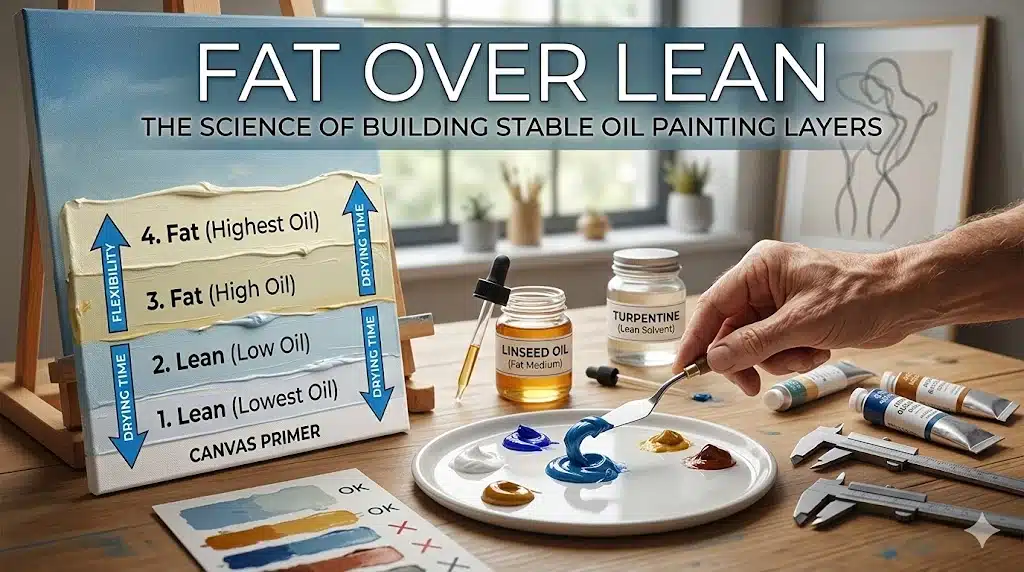
In simple terms, “fat over lean” means that each new layer of oil paint should contain slightly more oil (and usually be a bit thicker and more flexible) than the one underneath.
The rule isn’t about making every layer greasy; it’s about making sure upper layers aren’t leaner and more brittle than the ones below. If a fast‑drying, rigid film sits on top of a slower, more mobile one, the top layer will crack or delaminate as the lower layer continues to move.
One technical guide sums it up: “Fat over lean refers to the idea that each successive layer in a painting should be more flexible than the one before. Faster drying underneath, slower drying on top. Less oil underneath, more oil on top.”
Oil paint doesn’t dry like acrylic or watercolor. It dries through oxidation—a slow chemical reaction where the drying oil (linseed, walnut, etc.) reacts with oxygen, forming a crosslinked polymer network.
Key consequences:
A recent set of guides and paint‑maker notes emphasise:
If you put a lean, rigid layer over a still‑moving, softer fat layer, the rigid skin gets stressed and develops cracks (often “alligatoring” patterns) as the underlayer continues to shrink and move. By stacking fat over lean, each new layer is at least as flexible as the one below. The whole paint film can move as a unit and is less likely to crack or flake.
One in‑depth article points out another factor: pigment volume concentration (PVC)—the ratio of pigment to binder.
Over‑thinning paint with solvent can push PVC too high, making layers under‑bound and vulnerable. That’s why “fat over lean” is not just about adding oil, but also about not over‑removing it with solvent.
Some painters think they’re required to add extra oil medium to each layer. Modern writers and some experienced painters argue that this is overly literal. One contemporary painter notes she doesn’t consciously make each layer fatter; she simply avoids putting lean, heavily solvent‑thinned paint over slow‑drying, glossy, oily layers.
If you mostly paint with paint straight from the tube (which is already “fat enough”), layering wet‑into‑wet or over thoroughly cured layers, you may already be safe without elaborate medium schedules. The key is avoiding lean over fat, not obsessively spiking every successive pass with more oil regardless of need.
Thickness and fatness often correlate—final layers are frequently both thicker and more oily—but they’re not identical:
The rule is fundamentally about oil content and flexibility, not simply paint thickness.
Recent discussion from realist schools note that “fat over lean” is a guideline, not an unbreakable law, and some modern painting systems (like alkyd‑based methods) can be more forgiving if used consistently. But ignoring it completely—especially with traditional oils and solvents—is still cited as a major cause of cracking and delamination.
Gamblin and other paint makers outline two main practical approaches.
You keep the same ratio of medium to paint in each layer, but change the medium’s fatness as you go up:
Here, you use one medium blend throughout (already containing oil), but adjust how much you add to the paint:
Gamblin describes this as keeping the same medium recipe but increasing the ratio of medium to paint as you build layers.
One detailed guide provides a clear “template” for four typical stages:
Purpose: tone the canvas or panel, establish initial values. Composition: paint heavily thinned with solvent, no added oil. Behaviour: dries quickly, forms a relatively rigid, absorbent film.
Purpose: establish major shapes, colours, and value structure. Composition: paint straight from tube or with minimal solvent; still little to no extra oil. Behaviour: relatively fast drying, firm underlayer with decent adhesion.
Purpose: develop form, refine edges, start adding texture and nuance. Composition: paint plus a small amount of linseed oil or alkyd medium; modest solvent. Behaviour: moderate drying speed, slightly more flexible film.
Purpose: final modelling, colour refinement, glazes, highlights. Composition: paint with more oil‑rich medium, or nearly straight paint plus a little stand/linseed oil for glazes. Behaviour: slowest drying, most flexible, typically glossier.
| Layer | Medium Type | Fat Level | Drying Speed |
|---|---|---|---|
| Underpainting | Paint + solvent | Lean | Fast |
| Mid-layer | Paint + solvent + small oil | Moderate | Medium |
| Final layer | Paint + oil (little/no solvent) | Fat | Slow |
Many modern failures come not from too little oil overall, but from over‑use of solvent. If you thin paint to the point where it’s mostly solvent and very little binder, you get under‑bound layers that are chalky, weak, and prone to cracking or flaking. Extremely lean layers on top of slightly fat underlayers can violate fat over lean and raise the risk of “alligator” cracking.
One article warns that about 80% of cracks in oil paintings are linked to ignoring fat over lean, often via overly thinned passages and improper stacking of lean over fat. So “lean” doesn’t mean “as much solvent as possible.” It means modest solvent, minimal added oil, and relying on paint’s natural oil content in early stages.
Alkyd mediums (e.g., Liquin, Galkyd) complicate the picture slightly by speeding drying while still adding flexibility and gloss. They allow reasonably fat layers to dry faster than traditional linseed‑only mixes. However, the underlying principle remains:
Even with alkyds, paint manufacturers still advise respecting fat over lean for relative flexibility and drying times across the stack of layers.
If you work alla prima or with only one or two passes, use paint straight from the tube or with just enough medium to handle well. Avoid heavy solvent thinning for later corrections. If you do need to glaze later, ensure the lower paint is fully dry and treat that glaze as a clearly fatter, upper layer.
If you build in multiple stages:
If you discover a problem late, scraping back to an earlier, leaner layer before repainting is usually safer than slapping a more solvent‑rich correction over a very oily surface. If you must paint over a glossy, fat layer, use a fat mixture (more oil/medium, very little solvent) and keep it thin to maintain flexibility.
Over years, ignoring fat over lean can show as:
Short‑term, you might notice upper layers wrinkling or “crazing” as slower‑drying paint underneath pulls them in, or surfaces that remain tacky or never fully harden.
Once you understand the science, “fat over lean” stops being an intimidating slogan and becomes a simple engineering principle: fast‑dry, rigid underneath; slow‑dry, flexible on top. Build your paintings that way, and your varnish truly can act as the final shield on a structure designed to last.
In simple terms, “fat over lean” means that each new layer of oil paint should contain slightly more oil (and usually be a bit thicker and more flexible) than the one underneath.
The rule isn’t about making every layer greasy; it’s about making sure upper layers aren’t leaner and more brittle than the ones below. If a fast‑drying, rigid film sits on top of a slower, more mobile one, the top layer will crack or delaminate as the lower layer continues to move.
One technical guide sums it up: “Fat over lean refers to the idea that each successive layer in a painting should be more flexible than the one before. Faster drying underneath, slower drying on top. Less oil underneath, more oil on top.”
Oil paint doesn’t dry like acrylic or watercolor. It dries through oxidation—a slow chemical reaction where the drying oil (linseed, walnut, etc.) reacts with oxygen, forming a crosslinked polymer network.
Key consequences:
A recent set of guides and paint‑maker notes emphasise:
If you put a lean, rigid layer over a still‑moving, softer fat layer, the rigid skin gets stressed and develops cracks (often “alligatoring” patterns) as the underlayer continues to shrink and move. By stacking fat over lean, each new layer is at least as flexible as the one below. The whole paint film can move as a unit and is less likely to crack or flake.
One in‑depth article points out another factor: pigment volume concentration (PVC)—the ratio of pigment to binder.
Over‑thinning paint with solvent can push PVC too high, making layers under‑bound and vulnerable. That’s why “fat over lean” is not just about adding oil, but also about not over‑removing it with solvent.
Some painters think they’re required to add extra oil medium to each layer. Modern writers and some experienced painters argue that this is overly literal. One contemporary painter notes she doesn’t consciously make each layer fatter; she simply avoids putting lean, heavily solvent‑thinned paint over slow‑drying, glossy, oily layers.
If you mostly paint with paint straight from the tube (which is already “fat enough”), layering wet‑into‑wet or over thoroughly cured layers, you may already be safe without elaborate medium schedules. The key is avoiding lean over fat, not obsessively spiking every successive pass with more oil regardless of need.
Thickness and fatness often correlate—final layers are frequently both thicker and more oily—but they’re not identical:
The rule is fundamentally about oil content and flexibility, not simply paint thickness.
Recent discussion from realist schools note that “fat over lean” is a guideline, not an unbreakable law, and some modern painting systems (like alkyd‑based methods) can be more forgiving if used consistently. But ignoring it completely—especially with traditional oils and solvents—is still cited as a major cause of cracking and delamination.
Gamblin and other paint makers outline two main practical approaches.
You keep the same ratio of medium to paint in each layer, but change the medium’s fatness as you go up:
Here, you use one medium blend throughout (already containing oil), but adjust how much you add to the paint:
Gamblin describes this as keeping the same medium recipe but increasing the ratio of medium to paint as you build layers.
One detailed guide provides a clear “template” for four typical stages:
Purpose: tone the canvas or panel, establish initial values. Composition: paint heavily thinned with solvent, no added oil. Behaviour: dries quickly, forms a relatively rigid, absorbent film.
Purpose: establish major shapes, colours, and value structure. Composition: paint straight from tube or with minimal solvent; still little to no extra oil. Behaviour: relatively fast drying, firm underlayer with decent adhesion.
Purpose: develop form, refine edges, start adding texture and nuance. Composition: paint plus a small amount of linseed oil or alkyd medium; modest solvent. Behaviour: moderate drying speed, slightly more flexible film.
Purpose: final modelling, colour refinement, glazes, highlights. Composition: paint with more oil‑rich medium, or nearly straight paint plus a little stand/linseed oil for glazes. Behaviour: slowest drying, most flexible, typically glossier.
| Layer | Medium Type | Fat Level | Drying Speed |
|---|---|---|---|
| Underpainting | Paint + solvent | Lean | Fast |
| Mid-layer | Paint + solvent + small oil | Moderate | Medium |
| Final layer | Paint + oil (little/no solvent) | Fat | Slow |
Many modern failures come not from too little oil overall, but from over‑use of solvent. If you thin paint to the point where it’s mostly solvent and very little binder, you get under‑bound layers that are chalky, weak, and prone to cracking or flaking. Extremely lean layers on top of slightly fat underlayers can violate fat over lean and raise the risk of “alligator” cracking.
One article warns that about 80% of cracks in oil paintings are linked to ignoring fat over lean, often via overly thinned passages and improper stacking of lean over fat. So “lean” doesn’t mean “as much solvent as possible.” It means modest solvent, minimal added oil, and relying on paint’s natural oil content in early stages.
Alkyd mediums (e.g., Liquin, Galkyd) complicate the picture slightly by speeding drying while still adding flexibility and gloss. They allow reasonably fat layers to dry faster than traditional linseed‑only mixes. However, the underlying principle remains:
Even with alkyds, paint manufacturers still advise respecting fat over lean for relative flexibility and drying times across the stack of layers.
If you work alla prima or with only one or two passes, use paint straight from the tube or with just enough medium to handle well. Avoid heavy solvent thinning for later corrections. If you do need to glaze later, ensure the lower paint is fully dry and treat that glaze as a clearly fatter, upper layer.
If you build in multiple stages:
If you discover a problem late, scraping back to an earlier, leaner layer before repainting is usually safer than slapping a more solvent‑rich correction over a very oily surface. If you must paint over a glossy, fat layer, use a fat mixture (more oil/medium, very little solvent) and keep it thin to maintain flexibility.
Over years, ignoring fat over lean can show as:
Short‑term, you might notice upper layers wrinkling or “crazing” as slower‑drying paint underneath pulls them in, or surfaces that remain tacky or never fully harden.
Once you understand the science, “fat over lean” stops being an intimidating slogan and becomes a simple engineering principle: fast‑dry, rigid underneath; slow‑dry, flexible on top. Build your paintings that way, and your varnish truly can act as the final shield on a structure designed to last.

Reliable flow and authentic mixing behaviors designed for technique development, studio training, and bold experimentation.
Maximum pigment loads, verified single-pigment purity, and premium binders engineered for permanence.