Building Confidence in Oils: 10 Beginner-Friendly Projects to Grow Your Painting Skills
Art Team
June 7th, 2026
No Comments
Oil Painting Curriculum: 10 Projects for Beginners
1. Getting Started: Why Projects Beat Theory
Reading about color theory and brush types has value, but confidence with oils really comes from finishing paintings. Structured projects give you a clear goal, a limited challenge, and a sense of completion. Each project below targets specific skills—values, edges, color mixing, or composition—without demanding advanced drawing.
Think of this as a curriculum: you’re not just “making pretty pictures,” you’re building a solid foundation one canvas at a time.
I. Preparation and Tools
1. Your Basic Beginner Toolkit
Before you dive into the projects, it helps to have a simple, reliable toolkit. You don’t need every color and brush on the shelf.
Supports: Small pre‑primed canvases or panels (e.g., 20×20 cm or 20×25 cm).
Brushes: A few hog bristle flats (sizes 4, 6, 8) and a softer synthetic filbert or round.
Solvent and medium: Odorless mineral spirits and a simple medium like linseed oil.
II. Foundational Value and Form Projects
1. Project 1: Single Object Value Study (Monochrome Mug)
Goal: Learn to see value (light and dark) without worrying about color. Value is what makes objects look three‑dimensional. If your values are right, the painting will read even in grayscale.
Process: Place a plain mug under a single, strong light. Sketch the silhouette with thinned burnt umber. Paint using three clear value families: light, midtone, and shadow. Focus on squinting to simplify value shapes.
2. Project 2: Simple Fruit Still Life (Color and Form)
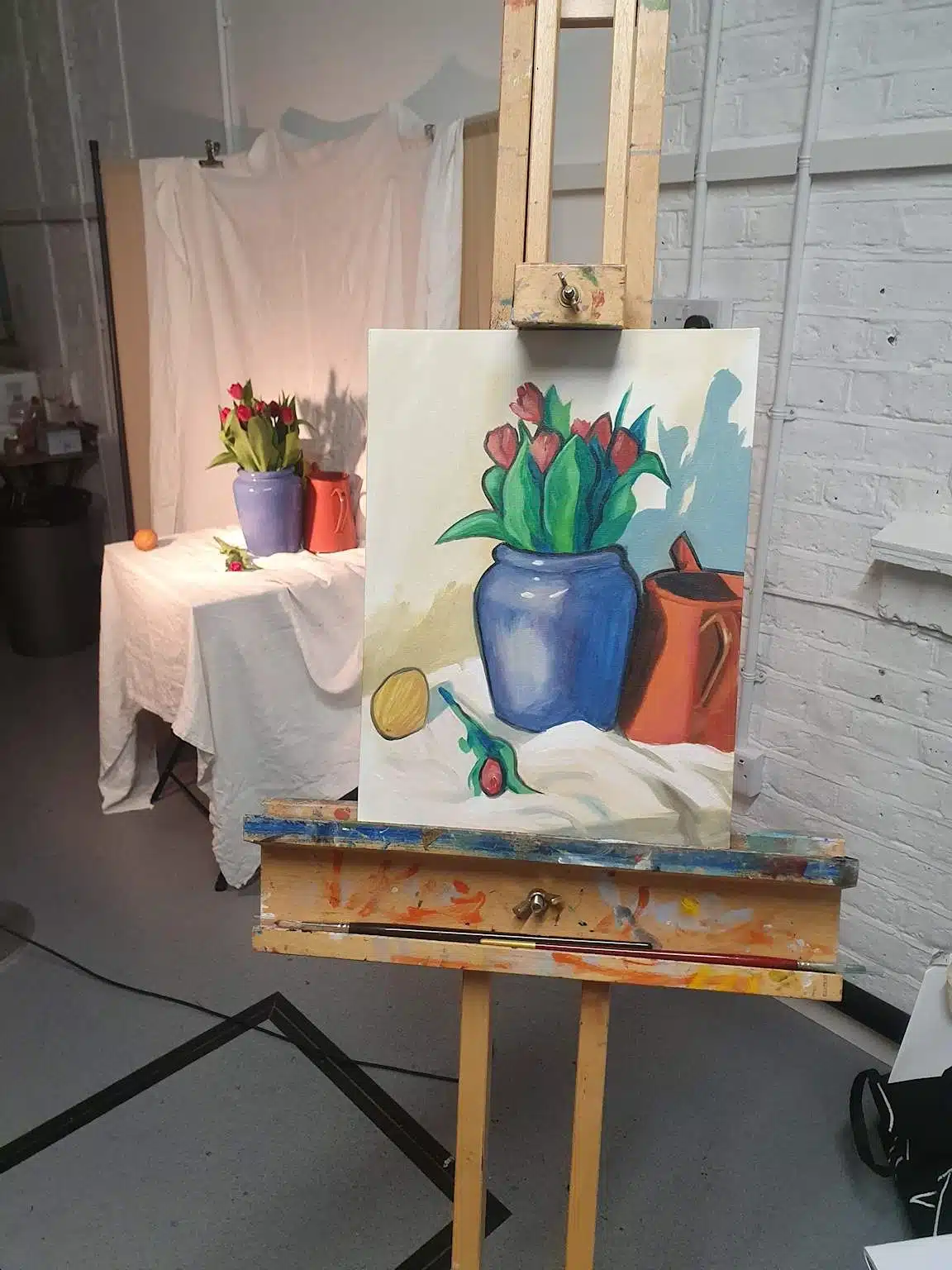
Goal: Combine basic color mixing with form and soft/hard edges. Still life is a classic beginner project because fruit is forgiving and stays still.
Key skills: Mixing warm and cool versions of a color, observing reflected light, and softening edges on the shadow side while sharpening edges where light meets dark.
3. Project 7: Monochrome Portrait or Head Study
Goal: Focus on proportion and value in a face without color complexity. Treatment as value blocks rather than “a face” makes this a fantastic learning tool.
Approach: Block in the head as a simple shape first, not features. Map the light side vs. shadow side clearly. Only then, carve in features with small shifts in value.
III. Landscapes, Seascapes, and Space
1. Project 3: Limited-Palette Landscape (Value and Atmosphere)
Goal: Learn landscape structure and atmospheric perspective. Reducing your palette simplifies decisions and focuses on big shapes.
Key steps: Tone the canvas with burnt sienna. Sketch big masses. Paint background to foreground, keeping distant shapes lighter, cooler, and less detailed. Save highest contrast for the foreground.
2. Project 4: Sunset Sky Study (Soft Blends and Color Transitions)
Goal: Practice soft blending and color gradation. Clouds and sunsets are beginner‑friendly because they have no “correct” drawing.
Process: Pre‑mix a sequence of colors: yellow, orange, pink, violet, then blue. Lay colors in bands and blend carefully where they meet using a clean, dry brush.
3. Project 5: Simple Seascape (Movement and Reflections)
Goal: Capture water movement and reflections with basic brushwork. This develops your sense of rhythm and repeating shapes with variation.
Key ideas: Sky color reflects in water; horizontal strokes suggest flatness; foam shapes have underlying shadow tones.
4. Project 6: Interior Corner in 1-Point Perspective
Goal: Introduce perspective and simple architecture without heavy drafting. An interior corner uses basic 1‑point perspective where all depth lines recede to a single vanishing point.
IV. Design, Harmony, and Consistency
1. Project 8: Abstract Geometric Composition (Design and Color Harmony)
Goal: Practice composition and color balance without realism. This trains your sense of design, which improves all representational work.
Process: Draw large geometric shapes. Choose a color scheme (complementary, analogous, or triadic). Assign values so no two touching shapes share the same value.
2. Project 9: Everyday Object Series (Repetition for Mastery)
Goal: Build fluency and speed by painting the same subject multiple times. Pick one simple object and paint it 5–10 times, changing light direction or color scheme each time.
3. Project 10: Mini-Series on a Theme
Goal: Connect paintings conceptually and practice consistency. Create a series of 3–5 small paintings that share common color notes or subject matter.
V. Managing Practice and Growth
1. Structuring Your Practice: A 10-Project Roadmap
You don’t need to complete these in exact order, but a logical progression moves from monochrome value studies into color, blending, perspective, and finally cohesive series work.
2. Managing Drying Time and Layers
Work “fat over lean”: early layers thinner (more solvent), later layers with more oil. Allow touch‑dry time between major sessions to avoid muddying. Aim for alla prima on small supports for these projects.
3. Evaluating Your Progress
After each project, note what worked (values, color, edges, composition) and what felt difficult. Comparing your first and tenth project will show progress easy to miss day‑to‑day.
4. Common Beginner Mistakes (and How These Projects Fix Them)
Mud in colors: Solved by limited palettes and restraint.
Flat objects: Addressed via monochrome value studies.
Overworked details: Fixed by small formats and repetition.
Fear of “ruining” a painting: Lower stakes through a focus on learning projects.
Curious how artists made oil paint before tubes? Learn the historical process of grinding dry pigments with linseed oil on stone or glass, plus tools, ratios, and workshop practices.
New to sgraffito? Learn what it is, how it works in acrylics and oils, which tools to use, and step‑by‑step projects to start scratching through paint for bold texture and…
Learn how to transform your sketches into expressive watercolor paintings. Covers planning, transferring drawings, line work, layering, and finishing techniques for artists at any level
Feeling stuck creatively? Discover proven strategies, mindset shifts, and exercises that help artists break through creative block, restore flow, and rediscover inspiration.
Optimize your art studio for comfort and long‑term wellness. Learn ergonomic design principles and habits to protect your back, neck, and wrists during long creative sessions.
Oil Painting Curriculum: 10 Projects for Beginners 1. Getting Started: Why Projects Beat Theory Reading about color theory and brush types has value, but confidence with oils really comes from…