Linseed Oil in Oil Painting: How It Works, How to Use It, and When to Be Careful
Art Team
June 6th, 2026
No Comments
The Artist’s Guide to Linseed Oil
1. Why Linseed Oil Matters So Much in Oil Painting
If oil paint had a backbone, it would be linseed oil. Most traditional oil paints are simply pigment plus linseed oil, sometimes with small additives. Linseed oil doesn’t just thin paint; it:
Binds the pigment particles together into a solid film.
Determines much of the paint’s drying speed, flexibility, and durability.
Affects gloss, transparency, and color saturation.
Understanding linseed oil is like understanding the “character” of oil paint itself. When you know how this oil behaves, you can make your paint fatter, leaner, glossier, more transparent, or more responsive—without guessing.
This guide unpacks what linseed oil is, how it behaves chemically, the main types you’ll see in art stores, and practical ways to use it in your daily painting.
I. Technical Properties and Roles
1. What Is Linseed Oil, Technically?
Linseed oil is a drying oil extracted from the seeds of the flax plant (Linum usitatissimum). “Drying oil” doesn’t mean it evaporates like water. Instead, it oxidizes when exposed to oxygen in the air, slowly polymerizing into a solid network. Chemically, it has a high proportion of linolenic acid, which makes the oil very reactive with oxygen, helping it form a robust, crosslinked film faster than many other plant oils.
2. Linseed Oil as Binder vs. Medium
In oil painting, linseed oil plays two roles:
Binder inside the paint tube: Part of the paint itself. Pigment + linseed binder = the basic oil paint.
Medium you add while painting: You can add extra linseed oil to alter the paint’s handling: flow, transparency, and gloss.
Binder is non-optional; without it, pigment won’t form a coherent paint film. Medium is optional; you can paint entirely with tube paint alone if you choose.
3. What Linseed Oil Actually Does to Paint
When you add linseed oil to your oil paint, you change several characteristics at once: flow and workability (paint becomes smoother), transparency (useful for glazing), gloss and color depth (colors look deeper), drying time (generally slower), and fat content (mixture becomes more flexible).
II. Types of Linseed Oil and Selection
1. Types of Linseed Oil You’ll Encounter
Raw (refined) linseed oil: Cleaned and refined; fluid and pale yellow.
Cold-pressed linseed oil: Mechanically pressed at lower temperatures; often considered higher quality.
Stand oil (polymerized linseed oil): Thicker and syrupy; dries to a smooth, enamel-like film.
Sun-thickened linseed oil: Thickened by exposure to sunlight; often used for glazing.
Boiled linseed oil (for wood/DIY, not art): Contains driers and additives; usually not recommended for fine art painting.
2. Raw vs. Stand Linseed Oil in Practice
Refined (raw) linseed oil is thinner and more fluid, ideal for everyday mixing and enriching colors. Stand oil is very thick and honey-like; it levels beautifully, minimizing brush strokes, and is generally reserved for mid-to-upper layers and fine, glassy glazes.
3. Advantages of Linseed Oil Compared to Other Oils
Linseed oil remains the workhorse binder because it dries relatively fast, creates a very durable film, and has high resistance to aging and cracking. Other oils like poppy or safflower may yellow less but can form weaker films or dry much slower.
III. Application and the Fat-over-Lean Principle
1. The Fat-over-Lean Principle and Linseed Oil
The fat-over-lean rule says that each successive layer should contain at least as much oil, or slightly more, than the one beneath it. Lean layers dry faster and become more brittle; fat layers dry more slowly and stay more flexible. Linseed oil is central to this because it determines how “fat” a mixture is.
2. Simple Ways to Use Linseed Oil as a Medium
Straight linseed oil: Mix a drop or two into your paint or dip your brush lightly into the oil. Start with very little. Linseed oil + solvent medium: A classic medium mix of solvent (turpentine or mineral spirits) and linseed oil. Ratios can be adjusted (e.g., 2:1 solvent:oil for leaner, 1:1 for balanced).
3. Practical Linseed Oil Strategies for Different Styles
Alla prima / direct painting: Work with paint straight from the tube and a touch of solvent or very small amount of oil.
Classical layered painting: Lean mixtures for early stages; modest oil for middle stages; richer oil or stand oil for final glazes.
Impasto: Avoid adding too much extra oil to keep the paint from slumping.
IV. Troubleshooting and Safety
1. Common Misuses and Problems
Wrinkled surfaces: Caused by too much oil in a single layer. Build up thin layers instead.
Very slow drying: Caused by excessive oil or cold environments. Use smaller amounts or combine with alkyd.
Excessive gloss: Adjust final sheen with varnish once the painting is fully cured.
2. Health and Safety Considerations
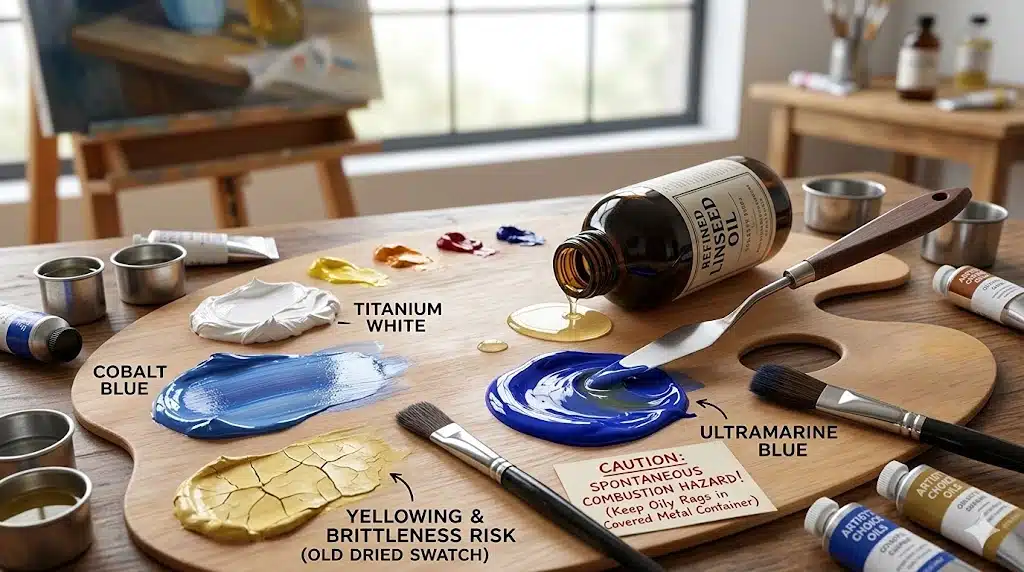
Rags soaked in linseed oil can self-heat and become a fire risk. Always spread oily rags out flat to dry fully, or submerge them in water in a sealed metal container before disposal. When combined with solvents, ensure good ventilation and avoid skin contact.
3. Myths and Clarifications
Myth: Linseed oil is always “fat.” Reality: Fatness is about the oil ratio in the specific mixture. Myth: Hardware store linseed oil is fine. Reality: It contains metal driers and unknown additives not tested for fine art.
V. Mastery and Experiments
1. Simple Experiments to Understand Linseed Oil
Try a Drying time test by creating swatches with varying oil ratios. Perform a Fat-over-lean study to see the stability differences between correct and incorrect layering. Compare Refined vs. stand oil to sense the difference in brushability and leveling.
2. Cleaning Up: Linseed Oil’s Role in Maintenance
Avoid leaving brushes sitting in pure linseed oil for long periods as it can gum up the bristles. Conditioning brushes with a tiny amount of oil after cleaning is possible, but dedicated brush soaps are often better.
Feeling stuck creatively? Discover proven strategies, mindset shifts, and exercises that help artists break through creative block, restore flow, and rediscover inspiration.
Struggling to pick between watercolor, acrylic, or oil? Learn how drying time, control, and personality traits like patience and pace determine which paint medium is the best fit for you.
Oil Painting Curriculum: 10 Projects for Beginners 1. Getting Started: Why Projects Beat Theory Reading about color theory and brush types has value, but confidence with oils really comes from…
Learn exactly how to stretch watercolor paper so it stays flat under heavy washes. Tools, soaking times, taping methods, drying tips, and common mistakes explained.
Confused by acrylic mediums? Learn what gels, fluids, retarders, and other additives actually do, how brands differ, and which ones are genuinely useful for your painting style.
Want the feel of canvas with the stability of a panel? Learn how to mount canvas or linen to wood boards using archival adhesives, avoid bubbles, and prevent cracking in…